Physical Address
304 North Cardinal St.
Dorchester Center, MA 02124
Physical Address
304 North Cardinal St.
Dorchester Center, MA 02124

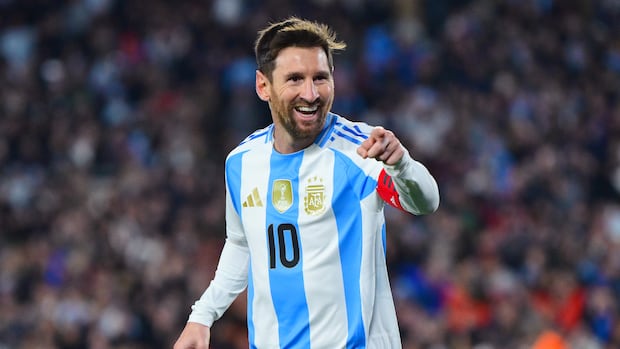
We’re now less than 48 hours from the start of the World Cup, which kicks off Thursday at 3 p.m ET with Mexico facing South Africa at the vaunted Estadio Azteca in Mexico City, followed by a nightcap between South Korea and Czechia in Guadalajara.
Co-host Canada’s first match is on Friday at 3 p.m. ET against Bosnia and Herzegovina in Toronto — the first men’s World Cup match ever held on Canadian turf. Later that night, the primary host United States takes on Paraguay in Los Angeles.
After that, soccer fans will be treated to at least three matches per day, and as many as six, as the group stage plays out over the next two weeks, with kickoff times ranging from noon ET to midnight ET across the three North American host countries.
To help get you ready for the planet’s most popular sporting event, here are some basics to know for the 2026 World Cup.
This is the biggest World Cup ever.
After launching in 1930 with just 13 countries, the tournament has now blown up to 48 — a 50 per cent increase from the 32 that played in the last World Cup in 2022 in Qatar.
As has been the case for decades, the teams are divided into groups of four for round-robin play. But, unlike the 32-team format, where only the top two in each group advanced to the single-elimination playoffs, this time the eight best third-place teams from the 12 groups will also move on as the knockout stage doubles in size from 16 teams to 32. That, as well as an influx of lower-ranked teams to fill out the expanded field, should make it easier for the top nations to advance, but could also sap some of the drama from the group stage.

On this episode of Soccer North, we break down Canada’s upcoming World Cup game against Bosnia and Herzegovina and discuss what Jesse Marsch and the Canadian men’s national team need to accomplish before the tournament begins. Plus, Canadian star Olivia Smith joins the show to reflect on her historic first season with Arsenal.
This is also the first World Cup to be played in three countries. The U.S. is hosting 78 of the 104 matches (75 per cent) across 11 different cities, while Canada and Mexico have 13 games each. The Canadian host cities are Vancouver and Toronto, which will each hold five games in the group stage and one in the round of 32 while Vancouver also gets a round-of-16 match. Everything from the quarterfinals onward takes place in the U.S., culminating with the final on July 19 at MetLife Stadium, home of the NFL’s New York Giants and Jets.
Some new rules are also being introduced.
As a reminder, a win in the group stage is worth three points, a draw is worth one and a loss is worth nothing. In previous World Cups, if two or more teams finished with the same number of points, their placing was determined by their total goal differential in their three group games. But, new this year, the first tiebreaker is now head-to-head result, followed by head-to-head goal difference, then head-to-head goals.
If that doesn’t resolve the tie, it goes to overall goal differential, then overall goals, then “fair play” points (teams are deducted for each yellow or red card they receive). Those same criteria are used to rank the third-place teams for advancement to the knockout stage.
Another notable change is that, regardless of the temperature, each match will include a pair of three-minute “hydration breaks” to allow players to grab a drink — and broadcasters to sell more ads. These will be called about midway through each half.
There’s no clear favourite.
Betting markets are a useful tool for identifying the top contenders, and right now they suggest that Spain and France are essentially co-favourites. But The Red (the reigning European champions) and The Blues (going for their third straight World Cup final after winning it in 2018 and then losing to Argentina in a penalty shootout in 2022 in Qatar) are each listed at around 5/1 odds to hoist the trophy, implying only about a 17 per cent chance.
Still, it’s tough to pick against these two. The deep Spanish team features 18-year-old Barcelona star Lamine Yamal, whose splendid strike against France in the semifinals of the 2024 European Championship (when he was only 16!) made him the youngest scorer in the history of that tournament. Yamal has been sidelined with a hamstring injury but is expected to suit up for Spain’s opener on Monday. The French are led by Kylian Mbappé, the marvellous Real Madrid forward who racked up 12 goals over the last two World Cups, including a tournament-high eight in 2022.
England is next with an implied chance of roughly 12 per cent to capture its first major trophy since the 1966 World Cup. The Three Lions, featuring high-scoring Bayern Munich striker Harry Kane, have lost two straight Euro finals, falling to Italy in 2021 (at London’s Wembley Stadium) and Spain in 2024.

It’s official, Canada Soccer’s national team is off to the FIFA World Cup. So how is the team feeling? CBC’s Dale Manucdoc caught up with them before the celebrations in Toronto’s harbourfront Monday evening.
After that, Portugal, Brazil and defending champ Argentina are clustered around 10 per cent. The Argentines seem a bit underrated here as they return pretty much the same core that helped the great Lionel Messi capture his first World Cup in 2022. But they’re four years older now, and the 38-year-old Messi is nursing a hamstring injury he suffered in late May with Inter Miami.
Brazil is hoping 34-year-old star Neymar can recover from a calf injury, while 41-year-old Portugal icon Cristiano Ronaldo is still seeking his first World Cup title as he prepares to play in the tournament for a record sixth (and final?) time.
Germany (just under 7 per cent) and the Netherlands (under 5 per cent) are next in the title odds, while every other country is below 3 per cent.
Italy’s odds are zero per cent after the world’s 12th-ranked team once again failed to qualify, this time thanks to a penalty-shootout loss to No. 64 Bosnia and Herzegovina in the final round of the European playoffs. The four-time World Cup champion Azzurri are the first multi-time winners to miss the tournament three times in a row.
Look out for some darkhorses.
While it would be a shock if anyone other than those aforementioned blue bloods wins the tournament, several other countries are capable of making some noise.
Norway is on the rise after pouring in 37 goals during a perfect 8-0 run through European qualifying, including a pair of decisive wins over Italy. The Norwegians haven’t played in the World Cup since 1998, but they’re now led by a global superstar in Erling Haaland, the towering Manchester City striker who topped the English Premier League with 27 goals this season and potted 16 in World Cup qualifying.
Croatia is hoping for one more run after reaching the 2018 final and placing third in 2022. Masterful midfielder Luka Modric, who won the Golden Ball award as the top player in ’18, remains the heart and soul of his greying team at age 40.
Morocco was the big Cinderella story four years ago in Qatar, upsetting Spain and Portugal in the knockouts to become the first African team ever to reach the World Cup semifinals before falling to France and then Croatia in the third-place match. They’re now ranked seventh in the world — the highest on their continent. Other top-20 teams generating buzz include Colombia, Senegal and Japan.
Home-field advantage has been big in the World Cup, with only two host countries failing to reach the knockout stage. The new, more-forgiving format will make that task even easier for Mexico, the U.S. and Canada — ranked 14th, 17th and 30th in the world, respectively — and their supportive crowds could even propel them to something more surprising, like host South Korea’s run to the semis in 2002.
How far can Canada go?
The Canadian men’s soccer team has come a long way in a short time. After ending their 36-year World Cup drought in 2022 by topping their regional qualifying table, Canada is set for a previously unimaginable second consecutive appearance — this time receiving an automatic entry as one of the host countries. The team has continued to make strides under head coach Jesse Marsch, who took over in 2024, reaching the semifinals of the vaunted Copa America that summer while beginning to attract more players with dual nationalities to Canada.
But there’s much work left to do. Canada is still looking for not only its first World Cup win but its first points after going a combined 0-6 with just two goals scored and 12 allowed in 1986 and 2022.
The good news is that the stars seem aligned this time for Canada to not only finally earn some points but advance to the knockout stage for the first time. The Canadians, ranked 30th in the world, appear to have landed in one of the softer groups. And all three of their matches will take place in front of home crowds — this Friday in Toronto vs. No. 64 Bosnia and Herzegovina, on June 18 in Vancouver vs. No. 57 Qatar, and on June 24 in Vancouver vs. No. 19 Switzerland. Plus, as mentioned, a third-place finish could now be enough to advance. A win and a draw would almost certainly do it, and even just one victory is likely to send a team through.
Except, it turns out that some stars have not aligned. Brilliant captain Alphonso Davies, Canada’s best player and one of the top wing-backs in the world, is doubtful for the opener with a hamstring injury and questionable for the rest of the tournament. Key centre-back Moïse Bombito could also be out due to problems with his surgically repaired leg, while midfielder Marco Flores tore his ACL a couple weeks ago (he was replaced on the 26-man roster today by Jayden Nelson). Canada’s other injury concerns include midfielders Jacob Shaffelburg and Ali Ahmed (hamstrings) and defender Alfie Jones (ankle).
Not ideal! But, hey, Canada is about to play in the World Cup. Again. In Canada. No matter what comes next, that’s something to celebrate.