Physical Address
304 North Cardinal St.
Dorchester Center, MA 02124
Physical Address
304 North Cardinal St.
Dorchester Center, MA 02124
An exchange between SpaceX CEO Elon Musk and NASA Administrator Jared Isaacman has brought renewed attention to one of the most ambitious concepts in space exploration: antimatter propulsion.
Musk wrote on X that “in the future, a trillion times a trillion dollars will be spent on making antimatter to travel to other star systems,” adding that future civilizations may measure wealth not in dollars but in “mass and energy.” Isaacman responded simply: “I support antimatter propulsion.”
While the idea sounds like science fiction, antimatter propulsion is a real area of scientific research that could, in theory, enable spacecraft to travel far faster than any propulsion system available today.
What is antimatter?
Antimatter consists of particles that are the mirror opposites of ordinary matter. For every particle of matter, there exists an antimatter counterpart with the same mass but opposite charge.
For example:
When matter and antimatter come into contact, they annihilate each other, converting nearly 100% of their mass into energy according to Albert Einstein’s famous equation: E = mc²
This makes antimatter the most energy-dense fuel known to science.
Just one gram of antimatter reacting with one gram of matter would release energy equivalent to tens of thousands of tonnes of TNT, making it vastly more powerful than chemical rocket fuels.
What is antimatter propulsion?
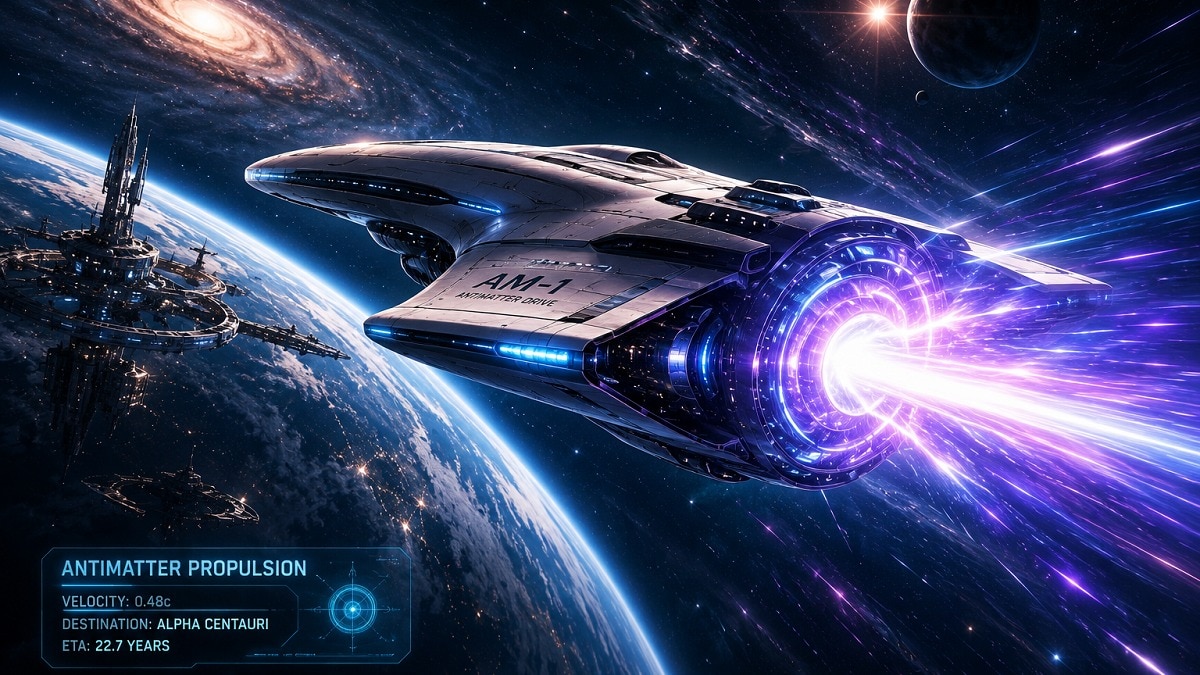
Antimatter propulsion refers to spacecraft engines that use the energy released during matter-antimatter annihilation to generate thrust.
The concept involves producing antimatter on Earth, storing it in electromagnetic containment systems, and then allowing controlled reactions with ordinary matter. The resulting energy could be directed to propel a spacecraft at unprecedented speeds.
Scientists have proposed several designs:
Why is antimatter considered a game-changer?
The biggest challenge in space travel is carrying enough fuel.
Chemical rockets, which power today’s missions, are relatively inefficient. Spacecraft often spend months or years reaching destinations within our own solar system.
Antimatter could dramatically reduce travel times because of its extraordinary energy density.
Potential advantages include:
Researchers have suggested that antimatter-powered spacecraft could theoretically reach a significant fraction of the speed of light, making journeys to nearby star systems more realistic.
How it can fuel future space missions?
What are the major challenges?
Despite its promise, antimatter propulsion remains far from practical.
Why Musk & Isaacman are interested
Musk has repeatedly argued that humanity must become a multi-planetary and eventually multi-star species. While SpaceX’s current Starship architecture relies on chemical propulsion, interstellar travel would require technologies far beyond today’s rockets.
Isaacman’s endorsement reflects growing interest among scientists and space leaders in breakthrough propulsion concepts that could eventually enable missions beyond the solar system.
Although antimatter propulsion remains decades — if not centuries — away from practical deployment, it represents one of the few known technologies that could theoretically provide the energy needed for humanity’s first journeys to other star systems.