Physical Address
304 North Cardinal St.
Dorchester Center, MA 02124
Physical Address
304 North Cardinal St.
Dorchester Center, MA 02124
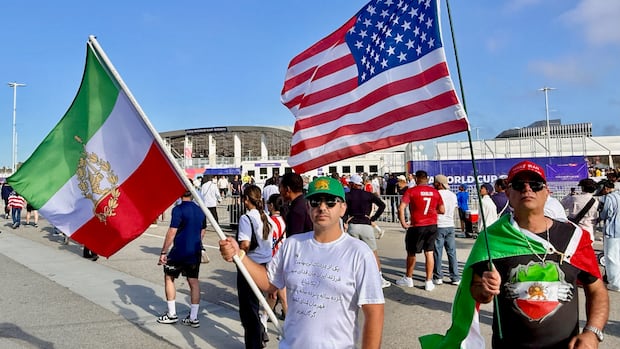
On a sun-soaked field in a quiet part of Los Angeles, Iranian American soccer players are deeply conflicted about a game they’ve been waiting years to see.
In only hours and only a short drive away, Team Iran will step onto the sport’s biggest stage to play its first game of the FIFA World Cup 2026 against New Zealand.
Soccer is Iran’s most popular sport, but many in southern California are divided over where their loyalties should fall this time around.
“I have lived in the United States or abroad for 47 years now, but still, the heart beats for Iran,” said Nader Adeli, the manager of Arya F.C., a group of mainly Iranians who have been playing soccer together for years around L.A.
Adeli is among thousands of Iranian Americans here who have protested against the Islamic regime in Tehran. But right now, he’s separating his feelings on politics and war from the game.
“It is soccer, it is football. It is the time that you want to be with your nation. It is a time that you want to see Iran be successful,” Adeli said.

A divisive collision of geopolitics and sports is playing out in a community with emotional ties to two countries at war, setting the stage for drama and protest that will go beyond the pitch.
On Sunday, the U.S. and Iran said they have reached a peace framework to end the monthslong war. The deal is scheduled to be officially signed on Friday in Switzerland.
“You’ve never had two countries engaged in active military conflict matching up against each other, competing in the same tournament,” said Salma Mousa, a Canadian and an assistant professor at the University of California, Los Angeles who studies the intersection of sports and conflicts.
The question for many in L.A. is whether to rail against or cheer on the Iranian men’s national team, which opponents view as an arm of the state.
Many in the city believe the Iranian government is using the World Cup to sportswash its killing tens of thousands of dissidents since the Islamic Revolution, with thousands killed as recently as during widespread protests in January.
In previous World Cups, including 2022 in Qatar, the Iranian diaspora rallied behind its national team, which stood in silence and did not sing Iran’s national anthem during its opening game.
Iranian Americans are more conflicted this time, with many feeling shame about the team’s participation. Some have demanded that FIFA boot the country out of the competition.
“If the team does really well, we all know that the regime is going to use it to further its propaganda,” said Reza Aslan, a professor and former CNN host whose family left Iran for California in 1979.

But he says he feels for the players because he believes any sign of resistance from them at this World Cup will not be tolerated by Tehran.
“This team has been told in no uncertain terms that even the slightest hint of protest is going to be brutally responded to by the regime. So what would the consequences be for the players if they did decide to do so?”
The tension is elevated further by where Iran’s first matches will take place.
Iran will play its first two World Cup games at Sofi Stadium in Inglewood, Calif., only kilometres from the western part of L.A. that’s often known as Tehrangeles, home to dozens of Persian restaurants, markets, and businesses.

Maryam Shojaei fought to overturn Iran’s stadium ban for women. She spoke with CBC Radio’s The Sunday Magazine about Iran’s love affair with soccer and how it feels to be a fan right now.
At least 230,000 people of Iranian descent now live in and around Los Angeles, according to the Pew Research Centerconsidered the highest concentration in the world outside Iran.
“All of the athletes, we support those guys. There is no conflict for me at all. Politics aside, I love my country and I love the sports in Iran,” Atabak Youssefzadh said inside the bustling Saffron and Rose Ice Cream shop.
Team Melli (“national team” in Farsi), as it’s known by Iranian soccer fans, has been through the wringer since the United States and Israel attacked Iran on February 28.
The team was one of the first to qualify for the World Cup, but in March Iran’s sports minister said the team couldn’t play in the World Cup because of the American attacks.
Days later, officials changed their mind, pushing FIFA to move the team’s games from the U.S. to Mexico to no avail.
U.S. officials, including Secretary of State Marco Rubio, voiced concerns about team staff’s ties to the Islamic Revolutionary Guard Corps, designated as a terrorist group in the U.S. and Canada.

The U.S. Department of Homeland Security said it had issued visas to all of Iran’s players on June 9 — only 10 days before the tournament — but said they will only be able to come into the U.S. the day before each of their games.
Several members of the Iranian squad were not given visas, including “key managerial and administrative members,” according to Iran’s football federation.
Iran forward Alireza Jahanbakhsh said the war and the tensions have made it hard for the team to focus, but their safety in the U.S. was not a major concern.
“I don’t think the group has that feeling as well in a sense of safety or that sort of situation, but of course if I’m honest with you, we are ready for different circumstances that might happen,” he told ESPN.
The symbol of protest against repression in Iran is the lion and sun, the emblem on the pre-revolutionary Iranian flag, and protesters plan to inundate Team Iran’s World Cup games with it, if they can.
According to the AthleticFIFA plans to continue its ban on the flag and related apparel in World Cup stadiums, claiming the symbolism violates its code of conduct.

The Iranian team has said that it will stop playing if banned flags or critical slogans appear in matches, but many in California are determined to get their message out.
Social media posts in Farsi are advertising buses organized to move people from nearby cities to Sofi Stadium before Monday’s game, where a protest is planned outside.
Other posts show an effort to raise thousands of dollars to buy tickets for the game so people can protest field-side.
“This team is not the team of the people of Iran because they were chosen by the IRGC,” said Ali Khorsand, who stood outside the stadium on Friday night, sporting a red hat emblazoned with the words “Make Iran Great Again.”
“People of Iran, they don’t have a voice. So we are here to be their voice, to demonstrate to the world that this regime is a terrorist regime, it’s not a real regime,” said Khorsand.
Politics and war aside, Iran’s team will compete in its seventh World Cup ranked 20th in the worldand it’s looking to move past the group stage for the first time.
That would bring the potential for a very heated showdown.

If both the U.S. and Iran finish second in their groups, they would play each other on July 3 in Arlington, Texas.
“That would increase tensions to kind of a cataclysmic degree,” worried UCLA’s Salma Mousa.
She hopes the head-to-head matchup won’t happen, and that Americans will instead be inspired by Iran’s “grit, heart, and sportsmanship” in the tournament.
“I really think people are going to see what the Iranian team is made of, and it will humanize their people on the whole,” she said.