Physical Address
304 North Cardinal St.
Dorchester Center, MA 02124
Physical Address
304 North Cardinal St.
Dorchester Center, MA 02124
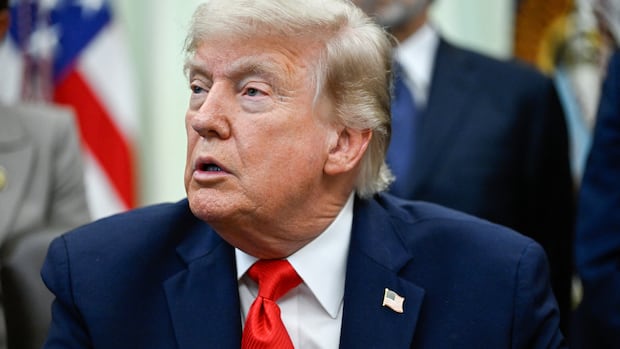
U.S. President Donald Trump said he had cancelled planned strikes against Iran on Thursday, hours after threatening more bombings and a desire to “take” oil export hub Kharg Island, hinting that a deal has been reached to end the war.
“Based on the fact that discussions with the Islamic Republic of Iran have been brought to the highest level of Iranian leadership and approved, I have, as President of the United States of America, cancelled the scheduled strikes and bombings against Iran this evening,” Trump wrote in a post on social media.
He later told reporters in the Oval Office that the Strait of Hormuz would be opened as soon as a “great settlement” of the war in Iran was signed — an event he said he expected would happen within days.
“We just made a great settlement of the war with Iran,” Trump said, without providing details.
“The strait will officially open as soon as we sign, which could be soon, very soon, maybe over the weekend in Europe,” he said. Trump added that he would not be there, but that U.S. Vice-President JD Vance would be.

In his social media post, Trump said “discussions and final points” have been approved by the United States, Israel, Saudi Arabia, UAE, Qatar, Turkey, Pakistan, Bahrain, Kuwait, Jordan, Egypt and others.
“The Naval Blockade will remain in full force and effect until this Transaction is finalized — Time and place of the signing to be announced shortly.”
When asked if Iran’s Supreme Leader Ayatollah Mojtaba Khamenei has approved the deal, Trump said: “I understand the answer is yes.”
But Iranian Foreign Ministry spokesperson Esmaeil Baghaei said Iran has not yet made a final decision on a possible agreement with the U.S. and will not compromise on its “red lines” in negotiations, according to Iran’s IRNA news agency.
Baghaei said reports regarding a time and place of signing the agreement remained speculative and that nothing had been finalized. He added that a large part of the negotiating text had been finalized but the U.S. repeatedly changed its positions during the talks.
Trump had earlier vowed to hit Iran “very hard tonight” and take control of its oil and gas infrastructure and markets.
“At some point in the not too distant future, we will be taking Kharg Island, and other oil infrastructure points, and assume total control of their Oil and Gas Markets, much like we have with Venezuela,” Trump wrote on Truth Social on Thursday morning.
The threat came as the U.S. and Iran traded air attacks, and the U.S. military launched new strikes on ships it said were trying to evade its blockade near the Strait of Hormuz.
It wasn’t the first time since the war began on Feb. 28 that Trump has threatened Kharg Island, the hub for 90 per cent of Iran’s oil exports. Any operation to control the island might necessitate ground troops, something U.S. officials speaking on the condition of anonymity to Reuters have previously said has been considered by the Trump administration.

U.S. President Donald Trump says a U.S. takeover of one of Iran’s most critical assets — Kharg Island — could happen “very easily,” but experts warn the reality is far more complicated. Andrew Chang breaks down why even a successful assault could lead to heavy losses and uncertain gains.
Images provided by The Canadian Press, Adobe Stock, Reuters and Getty Images
In response to Trump’s earlier threats, the head of the national security committee in Iran’s parliament, Ebrahim Azizi, told state media that the U.S. president would receive a stronger and more painful response if he made any “uncalculated” move.
The war has killed thousands of people, mainly in Iran and Lebanon, and pushed up global oil prices since the U.S. and Israel launched heavy airstrikes on Iran. The conflict has become a political headache for the White House, with polls showing Trump’s approval ratings sinking amid voter anger over high gasoline prices.
The U.S. blockade on Iran’s ports and Tehran’s grip on the Strait of Hormuz have sustained mutual pressure, driving up costs around the world while leaving the risk of renewed fighting unresolved.
Three Indian sailors died late Wednesday when the U.S. struck a tanker off Oman as part of its efforts to blockade Iran-linked shipping, India said on Thursday, after summoning a U.S. diplomat to demand an end to such attacks.
The U.S. military’s Central Command (CENTCOM) said a U.S. aircraft carried out a precision strike on the engine room of the Palau-flagged tanker Settebello after its crew “repeatedly failed to comply with directions from American forces.”
CENTCOM claimed the Settebello was trying to transport oil from Iran.
The Omani navy responded to the ship’s distress call after the strike, according to the British maritime risk management group Vanguard.
India’s Foreign Ministry said 21 Indian sailors were rescued.

The deaths are the first reported since the blockade began on April 13, operations which have seen the U.S. disable eight ships and turn back more than 100 others.
The U.S. military said on Thursday it had disabled another oil tanker in the Gulf of Oman — shooting two Hellfire missiles into the engine room of the Guinea-Bissau-flagged M/T Jalveer after, CENTCOM claimed in a statement, its crew also failed to comply with directions.
A third, unladen India-linked oil tanker was also stopped in the gulf on Monday.
“These attacks must cease,” said Indian Foreign Ministry spokesperson Randhir Jaiswal.
The three incidents come ahead of next week’s G7 summit in France, where Indian Prime Minister Narendra Modi has been invited and is likely to hold bilateral talks with Trump.
Ships being targeted by the U.S. blockade include Iranian vessels and so-called shadow fleet tankers. These are typically older vessels without Western insurance used to transport sanctioned oil sailing under the flags of various nations to obscure their true ownership, cargo and movements.
Attacks were also exchanged Thursday over land, with the U.S. military saying it had targeted “military surveillance capabilities, communication systems, and air defence sites across Iran” in response to what it called Tehran’s “unwarranted and continued aggression.”
Iran’s Islamic Revolutionary Guard Corps (IRGC) said it had launched counterattacks on 18 U.S. military targets at airbases in Kuwait and Bahrain, as well as the U.S. navy’s Fifth Fleet in Bahrain. It later said it had also targeted the al-Azraq airbase in Jordan for a second night running, firing 12 ballistic missiles.

Bahrain’s Interior Ministry said an 11-year-old girl suffered minor injuries, while vehicles caught fire and homes were damaged in the town of Hamad and the capital, Manama, after debris fell from Iranian drones that were intercepted and destroyed.
Iran on Wednesday accused the U.S. of striking reservoirs that supplied drinking water to 10 villages and violating international law.
“This is not collateral damage — it is a calculated war crime and a flagrant violation of human rights,” said Foreign Ministry spokesperson Esmaeil Baghei.
The Pentagon did not immediately respond to a request for comment on that claim.
Tehran’s demands in order to halt fighting include an end to Israel’s attacks in Lebanon, the lifting of sanctions on Iran, the release of billions of dollars in frozen assets, and recognition of its control of the Strait of Hormuz.
Trump says Iran must end its restrictions on shipping through Hormuz and that any peace deal must ensure Iran cannot develop a nuclear weapon.