Physical Address
304 North Cardinal St.
Dorchester Center, MA 02124
Physical Address
304 North Cardinal St.
Dorchester Center, MA 02124

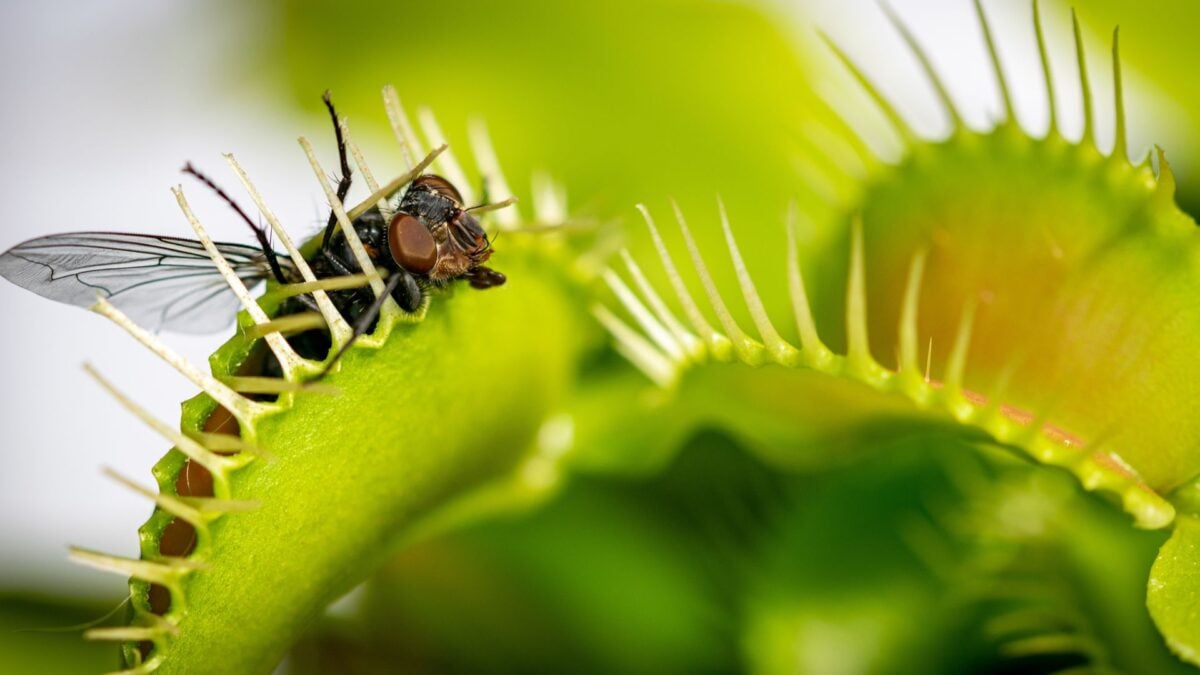
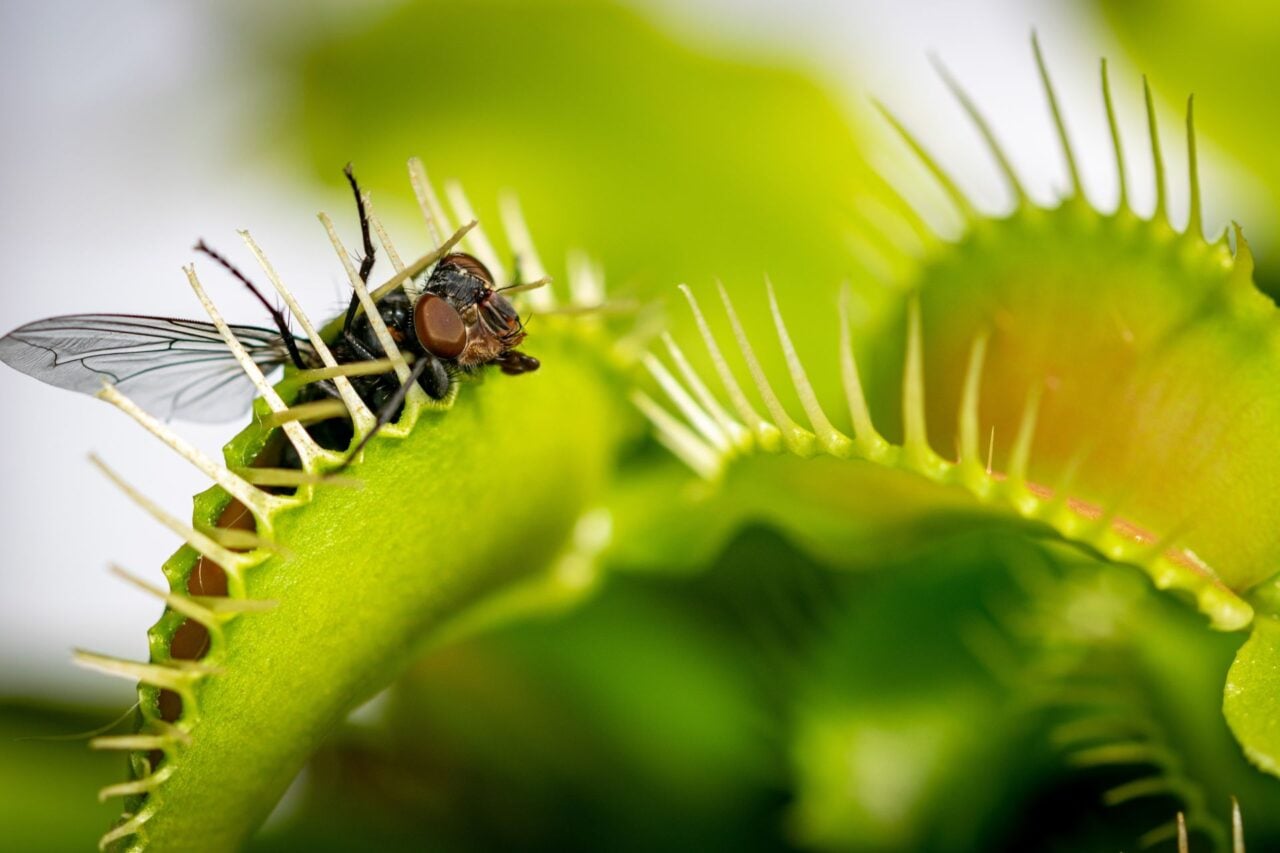
A study out this week appears to have solved one of the plant world’s greatest mysteries: Just how exactly does the trap of a Venus flytrap (Dionaea muscipula) first spring into action?
Researchers at Aix-Marseille University in France examined a Venus flytrap up close. They found evidence that the plant begins its closing motion by quickly softening the cell walls lining its outer epidermis. The team’s work sheds new light on the flytrap’s unique way of life and could help lead to new avenues of robotics research, they say.
“Overall, our findings establish the Venus flytrap not only as a key model for fast plant signaling but also as a powerful system to study dynamic cell wall mechanics,” the researchers wrote in their paper, published Thursday in Science.
Flytraps are some of the strangest living things in the world. Unlike most other plants, they can rapidly respond to animals, and they do so for the sake of a meal. The plant’s two leafy lobes (the titular trap) shut in response to insect prey triggering the hairs found inside, sealing the hapless bug inside so the plant’s digestive enzymes can break it down into a nutritious juice. Remarkably, all of this is done without the need for muscles.
Over the years, scientists have worked out much of the complex biology involved in this feeding ritual. A 2016 study, for instance, found that a flytrap can “count” the number of stimulations its lobes receive, helping it to distinguish between prey and a wayward brush from something it can’t eat. Another study last year found the molecular mechanism that alerts the entire plant to “know” when it should shut its trap.
Scientists still hadn’t figured out the mechanics of how this closing action starts, though—until now, it seems.
According to the research team, led by Jeongeun Ryu, there have been two major hypotheses to explain this. One involves the moving of water to the outer cells of its lobes; this might be akin to someone pushing a door closed. The other theorizes the walls of these outer cells suddenly relax, releasing the built-up energy inward; this might be like someone letting go of a spring they’ve been pushing on.
In this new study, the researchers tried to empirically look for the signs of either mechanism happening in flytraps as their lobes began to close shut.
Ultimately, they found that water moved too slowly across cells during the initial closing of a plant’s lobes for it to be the main driver of this action. Instead, they observed a rapid, one-second-long “softening of the epidermal cell wall, releasing elastic energy stored in the trap.”
The flytrap’s cell trick appears to represent “the fastest modulation of wall mechanics reported in plants,” the researchers wrote. And it might help inspire new techniques to help soft robots and other smart materials move without muscles, they add. That said, future studies will still need to work out the precise molecular method for this softening in the plant.
The Venus flytrap isn’t the only carnivorous plant out there, and at least some plants use slower trapping mechanisms that could rely on water movement entirely. So being able to figure out how these plants compare to each other could eventually reveal more about the winding evolutionary paths they took to get there, according to Jacques Dumais, a plant biophysicist not affiliated with the research.
“By clarifying the importance of wall relaxation in driving the closure of the Venus flytrap, Ryu et al. have filled a large gap in the current understanding of how such intricate adaptations can arise from a piecemeal evolutionary process,” Dumais wrote in an accompanying editorial for Science.