Physical Address
304 North Cardinal St.
Dorchester Center, MA 02124
Physical Address
304 North Cardinal St.
Dorchester Center, MA 02124


Listen to this article
Estimated 4 minutes
The audio version of this article is generated by AI-based technology. Mispronunciations can occur. We are working with our partners to continually review and improve the results.
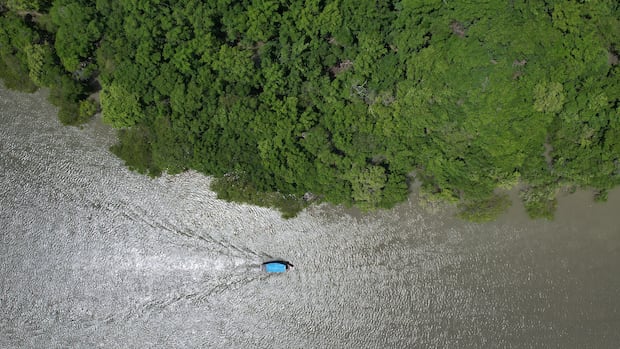
After decades of decline from human development and extreme weather, the world’s mangroves are growing again, according to a surprising new study looking at satellite images of coastal forests.
Zhen Zhang, lead author and postdoctoral researcher at Tulane University in New Orleans, says the study points to early signs that restoration and conservation efforts are working.
More than human efforts, Zhang said mangrove forests have shown resilience and recovery on their own.
Mangroves provide huge benefits for local communities. They are important habitats for fish and marine life, supporting crucial fisheries that feed millions. They protect coastal areas from flooding and storms, which is becoming more important in the face of rising sea levels and extreme weather caused by climate change.
They also store more carbon than other forests, making them essential in the fight against global warming.
Using satellite imagery from NASA’s Landsat program, the researchers were able to build a detailed picture of global mangrove forest canopy over time.
Mangroves have been declining since the 1980s, the study found, but since 2010 there has been more expansion than decline.

The data showed that two-thirds of the mangrove expansion happened over new areas of the sea, while the rest was through regeneration in previous areas of forest.
The surprising finding does not mean mangroves everywhere are healthy. The study said the forests are facing losses in parts of West and Central Africa.
Zhang said that mangroves are sensitive to extreme weather, which can quickly destroy years of progress. As examples he pointed to a winter freeze in Texas five years ago and sea-level rise causing erosion in 2022-23 in French Guiana.
It means that while mangroves do regenerate themselves naturally, those gains still need to be protected.
“The fate of mangroves in the future totally depends on whether we can keep lowering the deforestation rate,” Zhang said.
But it’s not all good news, even as the study is shared around the mangrove research community.
Heather Stewart is a biologist at the U.S. Fish and Wildlife Service working at wildlife refuges in Florida that include mangrove forests. She says that while it is encouraging to see mangroves expand, that doesn’t fully make up for earlier declines.
“They’re still at a loss from that original point where the study starts. So it’s still not back to those 1980 levels,” said Stewart, who was not involved with the Tulane study. “We still have a long way to go.”
The new mangrove areas are also not the same as older, mature forests, Stewart said. As the study mentions, the new areas are likely made up of younger trees that don’t provide the same levels of carbon storage and other ecosystem benefits that older forests provide.

“If you are losing mature forest, an acre of or hectare of that mature forest is not equivalent to the same area of these younger, newer mangroves,” she said.
The overall mangrove gains are a “positive trajectory,” Stewart said, but individual forests deliver different benefits to local areas — supporting different kinds of marine species, filtering the water supply or defending against floods.
Even if overall mangrove cover rises, those local benefits can be lost if mangroves move to new areas.
“We really need to focus on stopping the deforestation and the deterioration of these mature mangrove forests,” she said. “Because the mature mangrove forests are going to be the ones that are most resilient, that are helping people the most.”