Physical Address
304 North Cardinal St.
Dorchester Center, MA 02124
Physical Address
304 North Cardinal St.
Dorchester Center, MA 02124



Esteemed though he might be, Roger Ebert was “wrong” about a fair few films in his time. He hated the original “Godzilla” and was one of several critics to turn their nose up at “Blade Runner” in 1982 — though he ultimately made amends by retrospectively awarding a perfect four stars to Ridley Scott’s sci-fi classic. One revered 1982 film he never did reverse course on, however, was “The Thing,” which he considered to be “a great barf-bag movie” and little more.
“The Thing” was the second (loose) film adaptation of John W. Campbell’s 1938 novella “Who Goes There?” The first came in 1951 with Christian Nyby’s movie “The Thing From Another World,” which John Carpenter loved enough to initially pass on directing his version: “The Thing.” Thankfully for all of us, Carpenter did end up directing the movie, ratcheting up the horror with his tale of an Antarctic research outpost menaced by a mysterious alien being. The film was both transgressive in its unwillingness to offer even a sliver of hope amid the resulting chaos and shocking in its use of special effects that, evidently, had Ebert’s stomach churning.
Sadly, something must have been in the hors d’oeuvres at whatever parties these critics were attending in 1982. They all had issues with “Blade Runner” and seemed almost unanimously put off by “The Thing.” Many were outright hostile to the latter, with The Los Angeles Times’ Linda Gross (via StoryScreenPresents) describing it as “bereft, despairing, and nihilistic.” Roger Ebert wasn’t quite as mean, but he still struggled to find any merit in the film beyond its special effects. The critic ultimately found it to be “disappointing for two reasons: the superficial characterizations and the implausible behavior of the scientists on that icy outpost.”
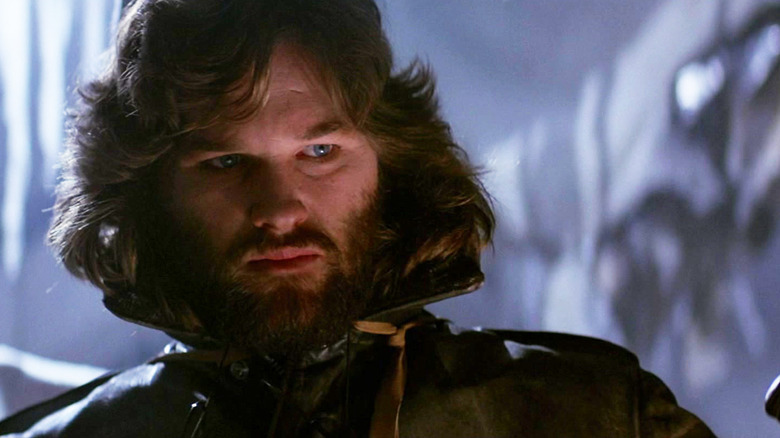
Legendary “The Thing” star Kurt Russell feels the movie wasn’t a hit partly due to the fact it bowed the same year as “E.T. The Extra-Terrestrial,” which buried both “Blade Runner” and “The Thing” at the box office. Others merely found the film to be one big bummer of a time regardless of whether you compared its murderous shapeshifting alien to the titular other-worldly visitor in Steven Spielberg’s classic blockbuster. According to Roger Ebert, however, “The Thing” was full of paper-thin characters making illogical decisions.
“Characters have never been Carpenter’s strong point,” wrote the critic in his two-and-a-half star review. “He says he likes his movies to create emotions in his audiences, and I guess he’d rather see us jump six inches than get involved in the personalities of his characters.” For some reason, the typically perspicacious Ebert failed to recognize how effective “The Thing” really was as a horror film when viewed as an exploration of paranoia and how it can awaken the monster inside us all. Instead, he simply couldn’t get past the admittedly irrational fact that even after the movie’s characters learn the alien is a shapeshifter who attacks when they’re alone, they fail to develop a “watertight buddy system.”
“Time and time again,” he wrote, “Carpenter allows his characters to wander off alone and come back with silly grins on their faces.” In fairness, these were the same characters dealing with a cosmic horror unlike anything the human mind has ever faced, so missteps of this sort are surely somewhat forgivable? In fact, I think that’s sort of the point. Still, Ebert was having none of it.
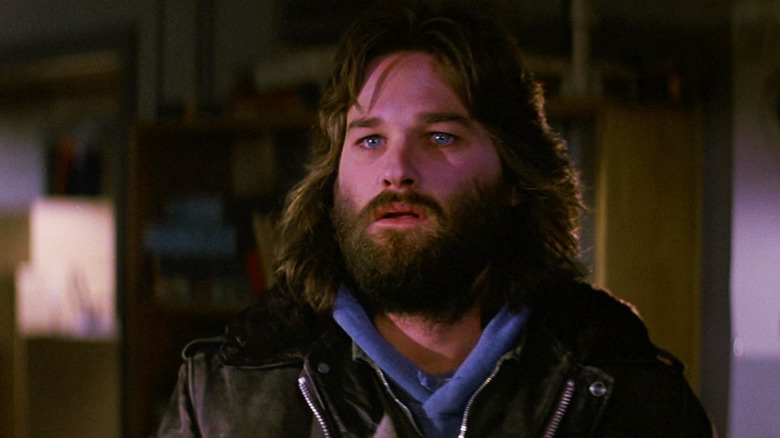
In their “Siskel & Ebert” review of “The Thing,” Gene Siskel and Roger Ebert highlighted the film’s “repellant special effects” — a phrase that scans as simultaneously complimentary and critical. Otherwise, while Siskel seemed to like Carpenter’s movie, there was more “The Thing”-bashing from Ebert, who said most characters’ functions were “to walk down the corridor and be jumped on” and once again criticized the implausibility of the scientists’ behavior.
Ultimately, as he wrote in his review, Ebert felt that John Carpenter had “made his choice early on to concentrate on the special effects and the technology and to allow the story and people to become secondary.” Amazingly, he also claimed that such a story had “been done before, and better,” using Ridley Scott’s “Alien” as an example — a movie that, three years prior, he’d dismissed as “basically just an intergalactic haunted house thriller.” It was only decades later that he retroactively bestowed a full four stars on “Alien” and brought it into the pantheon of sci-fi movies to earn a perfect score from Roger Ebert.
Unlike with “Alien,” or “Blade Runner” for that matter, Ebert never changed his mind about “The Thing.” The most he ever wrote in the years following his original review was Carpenter’s contribution to the lineage of “Who Goes There?” adaptations had been to “take advantage of three decades of special effects to make his creatures Awful Gooey Things from Space” and that “that was done well in his film.” Not well enough to earn the movie a classic Ebert reprieve, but well enough to, as he put it, prompt teenagers to “dare one another to watch the screen.”