Physical Address
304 North Cardinal St.
Dorchester Center, MA 02124
Physical Address
304 North Cardinal St.
Dorchester Center, MA 02124


Listen to this article
Estimated 3 minutes
The audio version of this article is generated by AI-based technology. Mispronunciations can occur. We are working with our partners to continually review and improve the results.
The Palestinian death toll from the Israel-Hamas war has surpassed 73,000, Gaza’s Health Ministry said Sunday, despite a fragile ceasefire that has been described as stalled.
Israel has continued to strike inside the territory despite the deal reached in October, saying it carries out strikes against Hamas and other militants who pose a threat, and in response to ceasefire violations, including occasional attacks. Five Israeli soldiers have been killed since the truce.
Confirmation of the latest Palestinian toll came from Zaher al-Waheidi, head of the ministry’s records department, and Hamza Salem from the ministry’s public relations department.
The number of deaths since the beginning of the war is now 73,001. On Sunday, the ministry said, there were five deaths: two in the southern city of Khan Younis and one in central Gaza, in addition to two who died of earlier wounds.
More than 173,200 people have been wounded since the start of the war, according to the Health Ministry.
The war was ignited by the Hamas-led Oct. 7, 2023, attack into Israel. That attack killed 1,200 people and took 251 others hostage, according to Israeli tallies.

The Health Ministry, part of the Hamas-led government, is staffed by medical professionals and maintains detailed records viewed as generally reliable by United Nations agencies and independent experts. It does not distinguish between civilians and militants but says women and children make up around half of all fatalities.
Israel says it tries to avoid harming civilians and blames their deaths on Hamas because the militants operate in densely populated areas.
The U.S.-brokered ceasefire deal reached in October ended full-scale military operations and led to the return of all the remaining hostages.
But other elements of the deal have stalled as Hamas has refused to disarm and Israeli troops have advanced in Gaza, rather than withdrawn. Both sides accuse the other of violating the agreement but say it is still in effect.
Progress on all other issues — including reconstruction, Israeli troop withdrawals and the establishment of a new Palestinian government — is being held up by the deadlock over disarming Hamas, the top diplomat overseeing the U.S.-brokered ceasefire in Gaza, Nickolay Mladenov, has said.

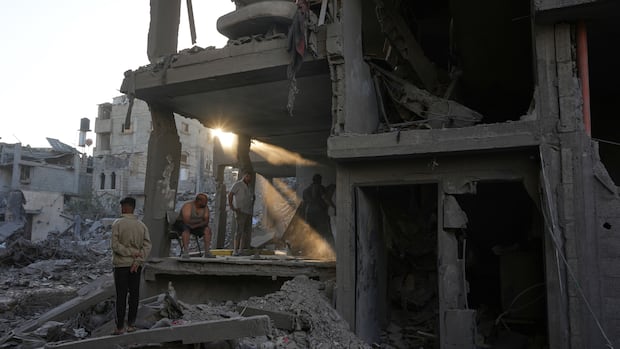
The war displaced most of the Palestinian population of more than two million, left large parts of the territory in rubble and created widespread shortages of food, medicine and other basic supplies as the border crossings with Gaza — all but one controlled by Israel — slammed shut.