Physical Address
304 North Cardinal St.
Dorchester Center, MA 02124
Physical Address
304 North Cardinal St.
Dorchester Center, MA 02124

Listen to this article
Estimated 5 minutes
The audio version of this article is generated by AI-based technology. Mispronunciations can occur. We are working with our partners to continually review and improve the results.
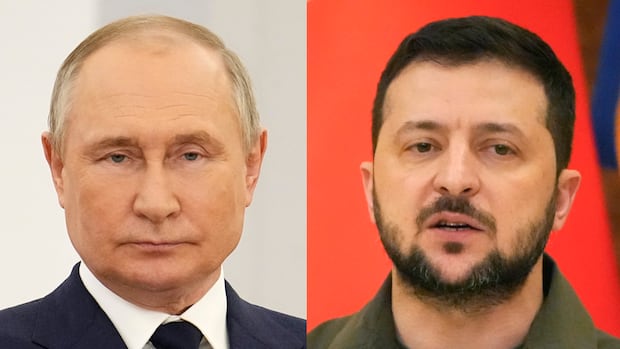
Russian President Vladimir Putin has been informed about an open letter from Ukrainian President Volodymyr Zelenskyy, Kremlin spokesperson Dmitry Peskov said Friday, according to state news agency TASS.
Zelenskyy published the letter to Putin on Thursday. It proposes that the two leaders meet to agree on an end to the war, warning that Kyiv stood ready to fight on otherwise. He also said Russians were getting tired of both him and the war.
Putin, who is due to speak later on Friday at his showcase economic forum in St. Petersburg, has yet to respond to the letter, but his spokesperson said he had been briefed on its contents.
In fighting on Friday, a Russian drone attack on a dairy factory in a region surrounding Kyiv left four people dead and seven wounded, Ukrainian officials said.
White House-led peace efforts have fizzled out as the sides made no progress on key differences and as the war in Iran became of greater concern to the Trump administration.
Zelenskyy’s appeal to Putin came three days after he publicly called on the U.S. to provide anti-ballistic missiles to Ukraine, amid a wave of Russian attacks.
Putin had repeatedly told Zelenskyy he needs to withdraw his troops from the rest of the Donbas region of eastern Ukraine if he wants the war to end.
The two have not met in person since 2019, at a multilateral summit in Paris, along with the leaders of France and Germany.
Zelenskyy has rejected that demand as akin to seeking Ukraine’s capitulation, and has said surrendering the territory would affect the fate of hundreds of thousands of people and leave the country dangerously vulnerable to further Russian attacks.
In the first year of the war, Putin signed treaties that were met with international condemnation to absorb Ukraine’s Donetsk, Luhansk, Kherson and Zaporizhzhia regions into Russia.
At the St. Petersburg forum on Thursday, Putin stuck to his hard-line stance on the war and said his troops were advancing on the battlefield every day. But he also said U.S. President Donald Trump’s proposals for peace could end the fighting if Kyiv was ready to compromise.
Democrat lawmakers and some Republicans in the U.S. have grown impatient with the Trump administration, questioning why $400 million US allocated for Ukraine months ago under the National Defence Authorization Act for Fiscal Year 2026 has not been dispersed.

Get the latest on CBCNews.ca, the CBC News App, and CBC News Network for breaking news and analysis.
U.S. Secretary of State Marco Rubio said this week to senators he expected “news on that pretty soon” as it was going through an interagency review. It’s similar to what Defence Secretary Pete Hegseth said in his own testimony weeks ago.
The U.S. House of Representatives passed legislation on Thursday to provide a separate aid package to Ukraine and impose new sanctions on Russia.
The House voted 226-195 for the Ukraine Support Act, which reached the floor after languishing for months. The act includes measures to help Ukraine rebuild after the war, authorizes more than $1 billion in assistance for Kyiv, and up to $8 billion in support via direct loans and imposes stiff sanctions and export controls on Russia.
Olha Stefanishyna, Ukraine’s ambassador to the U.S., praised the passage on X as an “important step.”
However, the future of the act is uncertain. To become law, it must be passed in the Senate, where Republican leaders have not allowed votes on Russia sanctions legislation that has broad bipartisan support, saying they would wait for Trump’s guidance.
If the act did pass the Senate, the bill would likely be vetoed by Trump.
In St. Petersburg on Thursday, Putin said that manpower, industrial resources and willpower were on Russia’s side in what is the fifth year of Europe’s deadliest land war since the 1940s.
His army had “recently” pushed Ukrainian forces out of nearly 2,500 kilometres of territory, he said, though he conceded Moscow had to and would improve its air defence to contend with a growing threat from Ukrainian drones.
Some Western and Ukrainian military analysts say Russia’s advance has slowed significantly, however, and argue Russia is still a long way from achieving its own stated military goals.
Putin also said Russia had not yet used its Oreshnik hypersonic missile against Ukraine in real combat conditions, but had only test-fired it to observe the results in order to make decisions about its future full-scale use, including against urban targets.
The Oreshnik, which Russia first fired against Ukraine in 2024, is a nuclear-capable missile with a range of over 5,000 kilometres. Putin has said before that it is impossible to intercept, though Western experts have questioned that assertion.
Putin also downplayed concerns about the war’s effect on the economy, though he called Russia’s Central Bank putting the country’s key interest rate at 14.5 per cent “a difficult decision.”