Physical Address
304 North Cardinal St.
Dorchester Center, MA 02124
Physical Address
304 North Cardinal St.
Dorchester Center, MA 02124

Listen to this article
Estimated 3 minutes
The audio version of this article is generated by AI-based technology. Mispronunciations can occur. We are working with our partners to continually review and improve the results.
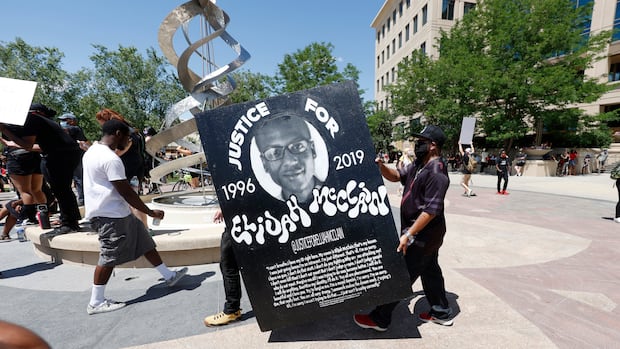
A Colorado court reversed homicide convictions against two paramedics on Thursday in the ketamine overdose death of Elijah McClain after the Black man was pinned down by police.
The appeals court ordered new trials for Aurora Fire Rescue paramedics Jeremy Cooper and Peter Cichuniec.
McClain, 23, had been forcibly restrained and put in a neck hold by police, who stopped him in response to a suspicious person complaint as the massage therapist walked home from a convenience store in the Denver suburb in 2019.
McClain’s final words — “I can’t breathe” — foreshadowed those of George Floyd who was killed by police a year later in Minneapolis.
A jury in 2023 found Cooper and Cichuniec guilty of criminally negligent homicide following a weekslong trial in state district court.
Cooper avoided prison and was sentenced to 14 months in jail with work release and probation. Cichuniec received five years in prison.
The appeals court upheld Cichuniec’s assault conviction, but faulted the instructions given to jurors with respect to the criminally negligent homicide charges before they deliberated.

Thursday’s ruling sends their cases back to a lower court for a new trial on that charge.
Cichuniec was released early from prison in 2024 after a judge reduced his sentence to four years of probation.
That judge, Mark Warner, cited “unusual and extenuating circumstances,” a part of Colorado’s mandatory sentencing law that allows a court to modify a sentence after a defendant has served at least 119 days in prison.
Warner said Cichuniec had to make quick decision the night of the arrest as the highest-ranking paramedic at the scene.
The Associated Press left a voice mail seeking comment with the attorney for McClain’s mother, Sheneen McClain. Other requests for comment were left with the lawyers for the paramedics and their union.
The paramedics’ defence attorneys argued they followed their training in giving ketamine to McClain after deciding he had “excited delirium,” a disputed condition invoked to justify excessive force that some say is unscientific.

Freeman, an expert in forensic medicine and epidemiology, talks about what he’s learned from reviewing the literature on excited delirium.
They also said prosecutors did not prove the sedative is what killed him.
Paramedics in Aurora had been trained to use the drug for the condition in 2018. State officials have since told paramedics to stop using excited delirium as a basis for administering ketamine