Physical Address
304 North Cardinal St.
Dorchester Center, MA 02124
Physical Address
304 North Cardinal St.
Dorchester Center, MA 02124
The 2026 World Cup anticipation is a mere shadow of the feelings that gripped Mexico when it hosted the 1986 tournament in the wake of an earthquake that devastated Mexico City, says writer and urbanologist Roberto Remes.
Remes, an expert on Mexico City who was a teenager during the ’86 tournament, said that tournament-related construction projects in Mexico City have increased daily frustrations, adding to a general feeling of apathy — if not antipathy — among locals toward the World Cup.
“I don’t feel that people are feeling positively for the World Cup,” said Remes, adding that the current makeover efforts seem designed for the foreign gaze.
Mexico, which is co-hosting the World Cup with the U.S. and Canada, has also seen some of the highest average ticket prices for its 13 games, putting attendance out of reach for the majority of the population and dampening the excitement in this soccer-mad country.
Mexico City is also bracing for protests from several groups and movements from across the country targeting the World Cup’s opening on Thursday.
Remes said the country “felt very proud” as it recovered from the 1985 earthquake, which left thousands dead and destroyed hundreds of buildings. He said Mexico pulled together and hosted one of the most memorable World Cups in the history of the tournament.
“Many public works were done because they were necessary, not to show something special for tourists,” he said.
“We were authentic.”

Mexico City’s decision to choose purple as a theme colour for its World Cup makeover, along with peppering the city with images of the axolotl — already featured on the 50 peso bill — and planting marigolds along prominent thoroughfares have drawn mockery across social media.
One video that recently went viral showed the flooded entrance to a city tunnel next to a mural of an axolotl, an iconic creature that is fighting extinction in Mexico. For many social media users, it was a metaphorical image that captured the contrast between World Cup makeovers and the city’s infrastructure needs.
“Invest in drainage instead of spending money to paint the country’s capital city purple with axolotls,” posted prominent Radio Reforma journalist Joaquin Lopez-Doriga, who shared the video with his 7.3 million followers.
The use of marigolds, a flower associated with autumn’s Day of the Dead celebrations and commemorations, has also drawn criticism, with references to cartel violence and the over 130,000 people registered as disappeared in the country.
“It’s logical that they have placed marigolds. It’s known that in Mexico every day belongs to the dead,” posted historian Alejandro Rosas on X.
However, Mexico’s governments have been doing their part to boost World Cup morale. Mexico City’s administration on Saturday helped organize what they hoped would be the largest human wave performed outside a stadium.
Local resident Teresa Lopez told Reuters that she joined the event to “support our national team” and to show “we are Mexican and very proud of our country.”
The federal Mexican government has also launched a project to repair and build thousands of soccer fields across the country.
Despite that, Mexico city Uber driver David Rosas, who plays in a local soccer league, said he isn’t feeling the vibe.
“I’m not excited. It’s more about business than the actual World Cup,” said Rosas.
“It hurts, it’s hurtful for many … that emotion you felt for Mexico’s games in the past, now it’s not like that, it’s not the same.”

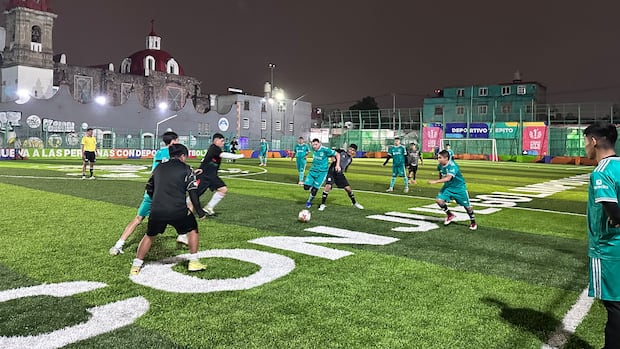
Last Friday night, beneath a light drizzle, the white lines across the artificial turf of a soccer pitch in the heart of Mexico City’s Tepito neighbourhood gleamed beneath the lights. It’s league game night, with matches scheduled until midnight.
This pitch is kept immaculate, it’s close to sacred ground. During the 1970 World Cup — the first hosted by Mexico — the victorious Brazilian side, including legend Pelé, stopped here for a pick-up match with the locals, said Salvador Gomez Hubert, who runs the league and oversees operations at the field.
Since then, the field has been known as the Maracaná of Tepito, after the famous Brazilian stadium, said Gomez Hubert.
He said that this World Cup “is not connecting with Mexicans” the way other tournaments have in the past.

“This World Cup is not for the people. The exorbitant prices are crazy. Nobody can go the games or even get an official team jersey,” said Gomez Hubert.
Tepito soccer player Iker Jiménez said he watched his grandfather and his father play on this field. Soccer is part of his family legacy.
Jiménez said he feels excitement for the World Cup and is looking forward to see how far Mexico can make it this time around.
He also believes the World Cup is much more than just a series of soccer matches.
“People live soccer differently. For me, the World Cup symbolizes unity,” said Jiménez, who scored the first goal of the game on Friday night.
“Unity between races, between countries.'”