Physical Address
304 North Cardinal St.
Dorchester Center, MA 02124
Physical Address
304 North Cardinal St.
Dorchester Center, MA 02124

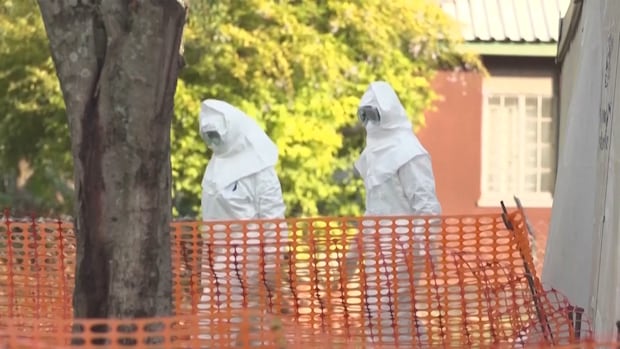
Oxfam country director Dr. Maneji Mangundu recently returned from the epicentre of the Ebola outbreak in the Democratic Republic of Congo. When asked how aid cutbacks affected the response, he didn’t hesitate.
“The flow of funding is so slow into the country,” he told CBC News from Kinshasa. “By now we would have have a lot of teams on the ground responding, doing contact tracing. But because of the limitation of the resources, it’s difficult.”
Mangundu compares the recent response to the Ebola outbreak of 2018, when he says the U.S. Agency for International Development, or USAID, rapidly sent a disaster support team that provided funding and support.
“At the moment we don’t have that,” he said. “The mechanism is broken.”
There are a host of challenges with this latest Ebola outbreak, the 17th the D.R.C. has weathered. Dr. Eve Robinson is an Irish doctor who travelled to the city of Goma to work with Doctors Without Borders. She describes what’s happening as “a crisis on top of crises.”
She says part of what’s complicated the response is the emergence of a relatively rare strain of Ebola, the Bundibugyo virus.

“It’s only the third outbreak of this virus, Bundibugyo disease, and because it’s so rare there hasn’t been as much research on it.”
Bundibugyo’s rarity means less diagnostic tools are available to confirm patients who have the virus and no vaccines to protect health-care workers surging into the eastern part of the country.
Adding to the challenges are the multiple armed conflicts in the same region where the outbreak is spreading. The Rwanda-backed M23 rebels have seized a number of cities including Goma, where Robinson is currently based.
Robinson says the outbreak response has been forced to change and adapt in rebel-controlled areas. “It’s trickier navigating the political situation.”

In addition the Allied Democratic Forces, a Ugandan Islamist group, have driven away health-care workers with violent attacks on civilians. According to Mangundu, the ongoing conflict took a serious toll on disease surveillance systems as staff have had to flee some areas.
These challenges seem to be compounded by funding cuts, Mangundu said.
“There have been cuts in humanitarian funding that have been announced and this has really affected our ability to rapidly scale up and go and start all those interventions that were to save lives on time.”
In the past three years aid from Western countries has shrunk dramatically, in particular as the Trump administration closed the doors of USAID and cut funding to the World Health Organization. In 2024, U.S. funding to the D.R.C. was at $1.4 billion US. By 2026 it had dropped down to $146 million US.

For Mangundu, this means less infrastructure in place to respond to outbreaks. It means longer waits to get his staff the personal protective equipment, and it means a delay in confirming infections as Ebola tests are sent to laboratories across the country.
One of the reasons why Ebola spread so rapidly at the outset, Mangundu says, is because there were few medical resources prepositioned in the area.
In a statement the U.S. State Department said it mobilized aid within 24 hours of the first confirmed case. The U.S. continues to be “the largest financial contributor to the Ebola response,” the department said this week.
But Mangundu sees a different reality on the ground, where something as simple as cleaning supplies aren’t always readily available.
“For example, we need chlorine for disinfection,” he said. “We have various teams moving into the villages, to support the communities and do the disinfection. We can’t have those teams at scale.”
But amidst the cause for concern, there are also signs of progress.
Speaking at a World Health Organization update on June 3, director general Tedros Adhanom Ghebreyesus confirmed there have been 60 deaths across 24 health zones. At the outset of the outbreak only three areas had registered cases.
But as staff and resources surge into the eastern provinces, the number of suspected cases had fallen dramatically from more than 1,000 in late May, to 116 the following week.

Dr. Robert Fowler has seen the difference international support makes. The Canadian critical care physician worked with the World Health Organization responding to multiple Ebola outbreaks in both the western and eastern parts of Africa.
Fowler says when he arrived in Guinea in 2014, the mortality rate for Ebola was 70 to 80 per cent. But with basic medical interventions such as preventing people from being very dehydrated, correcting organ dysfunction, they were able to bring the mortality rate under 40 per cent.
Speaking with CBC News in Toronto, he says he’s dismayed by what he describes as a shift and changing mood regarding international support, co-operation and funding.
“At the onset of this outbreak, what was needed a lot and what they didn’t have were diagnostic testing equipment to detect this particular strain. More resources to a region like the D.R.C. would help.”

When asked if the current outbreak is spreading quicker because of the lack of support, Fowler is definitive. “Absolutely. More aid leads to a quicker response, which leads to containment of an outbreak more quickly.”
Fowler says as aid drops, the consequences are global.
“As countries back away from providing that aid to different parts of the world, then you are going to put the rest of the world and therefore everyone at risk of having an outbreak that spreads undetected and then spreading geographically to other areas.”