Physical Address
304 North Cardinal St.
Dorchester Center, MA 02124
Physical Address
304 North Cardinal St.
Dorchester Center, MA 02124
A Mount Everest Sherpa guide was found crawling back to base camp a week after he went missing and was safely reunited with his family, who were uncertain if he would return.
Dawa Sherpa, 52, was last seen May 29 at a spot called Yellow Band above Camp 3 at 7,200 metres (23,622 feet). Base camp is at 5,300 metres (17,388 feet), but he failed to reach it even though his client did, The Associated Press reported.
The pair were among the last on the mountain as the climbing season drew to a close and their route down was dismantled.
Dawa was spotted by a cleaning crew on Thursday morning, crawling down the snow-capped slopes close to the Khumbu Icefall, just above base camp, Pemba Sherpa of 8K Expeditions, which co-ordinated the search, told the AP.
The crew transported him to safety and provided food and water. Dawa was flown by rescue helicopter to HAMS Hospital in Kathmandu, Nepal’s capital, where his wife and daughter, who had already begun funeral rituals, were waiting for him.

Get daily Canada news delivered to your inbox so you’ll never miss the day’s top stories.
“We first heard that he was still alive on the local news and from a person we know who called with the news that … he is being brought down,” his wife, Damu Sherpa, said.
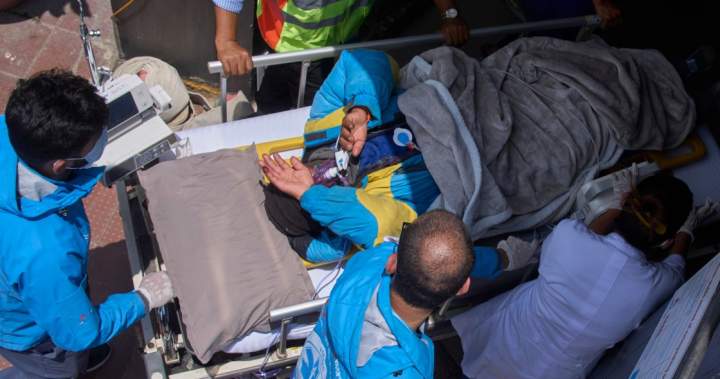
Medics treat Dawa Sherpa, a mountain guide who had been missing for several days in the Everest region, after he arrived at HAMS Hospital in Kathmandu, Nepal, on June 4, 2026.
Despite Dawa having been missing since last week, a search-and-rescue team was delayed in deploying. When helicopters were finally sent to find him, Dawa was nowhere to be seen. His family had given up hope and were on the second day of a days-long funeral ritual when news of his rescue reached them.
“When we first heard about it (the rescue), we could not be sure if that person was indeed our father,” his daughter Mendo Lhamu said. “So, to be certain, we asked for photos to be sent and then only we were sure and very happy.”
The team that spotted Dawa was part of the Sagarmatha Pollution Control Committee, which is responsible for placing the ladders and ropes at the start of each climbing season and then removing the equipment and cleaning up after its closure.
Dawa comes from the town of Okhaldhunga, south of Everest, and is employed by a small Kathmandu-based company called Himalayan Traverse. He was guiding a Polish climber when he went missing.
His survival has been widely hailed by the Sherpa community as extraordinary.
“This is nothing short of a miracle surviving so many days on the mountains facing such harsh condition,” Ang Tshering Sherpa, a leading figure in the community, told the AP.
“Sherpas are built tough growing up in the mountains,” Ang Tshering added. “If there was someone else in his place, they might not have survived.”
Members of the Sherpa community were mostly yak herders and traders living deep within the Himalayas until Nepal opened its borders in the 1950s; their stamina and familiarity with the mountains quickly made them sought-after guides and porters.
The storied history of Sherpas in the region, which dates back tens of thousands of years, has also made them renowned mountaineers with exceptional resilience to hypoxia, according to a study published in the National Library of Medicine, eventually allowing them to dominate the Himalayan climbing business.
More than 1,000 climbers and their guides scaled Everest this May, which was the busiest climbing season ever on the world’s highest mountain. It began late because of a massive ice block on the route just above the base camp that took about two weeks to clear.
In October, more than 300 climbers became stranded on the world’s highest peak amid freak blizzards that trapped them at elevations above 4,900 metres (16,000 feet).
In April, some Everest guides were accused of taking part in an alleged USD$20 million insurance scam involving fake rescues and fraudulent hospital admissions to claim insurance money.
— with files from The Associated Press
© 2026 Global News, a division of Corus Entertainment Inc.