Physical Address
304 North Cardinal St.
Dorchester Center, MA 02124
Physical Address
304 North Cardinal St.
Dorchester Center, MA 02124
It’s amusing that critics still use the phrase “revisionist Western” to describe the Westerns that weren’t made during Hollywood’s Golden Age, given the timeline of the genre. The Golden Age of Westerns — that is, when the genre was the most popular — extended from the late 1930s through the late 1950s, and encompassed films like “Stagecoach,” “The Ox-Bow Incident,” and “Gunfight at the OK Corral.” Revisionist Westerns began appearing as early as the 1960s, usually marked by a baked-in criticism of the previous generation’s Westerns. Revisionist Westerns were grim, dirtier, and often more violent. Most importantly, they lambasted the brazen, all-American heroism of the Old West cowboy, often starring antiheroes and scoundrels. Here’s some shorthand: if you see John Wayne, it’s Golden Age; if you see Clint Eastwood, it’s revisionist.
It speaks to the legacy of Golden Age Westerns that filmmakers are still, almost 70 years later, making revisionist Westerns that deconstruct ancient Western tropes. The Western is a lasting legacy in the American subconscious, and John Wayne rests at its center. Wayne died in 1979, and filmmakers have been symbolically trying to kill his legacy ever since. The Western is a conversation, an example of an art form at war with itself.
By the 2000s, Westerns were all over the place, and filmmakers exploited the genre’s tropes and classic Western style using equal parts enthusiasm and sardonic irony. Westerns were now either style exercises or an opportunity to mourn the violence at the heart of a nation’s history. Heck, American Western tropes have been transposed to other countries, and the genre can be used to unpack any country’s politics. Three of the film fims below don’t come from the United States.
And they’re all great movies. Go West. Life is violent there.
Wisit Sasanatieng’s 2000 film “Tears of the Black Tiger” is a satire so arch, one may not immediately grok that it is a satire. One might just see it as a violent, oversaturated, ultra-stylized action melodrama, one of many that rose in the wake of “Pulp Fiction” in the mid-1990s. “Black Tiger,” however, overplays its hand on purpose as a way to take down the broad, silly, overwrought Thai melodramas of the 1950s. Cinematographer Nattawut Kittikhun captured the film grain and color palette of an old-timey melodrama, giving “Black Tiger” the vibrant sheen of a pristine IB Technicolor print.
The story of “Tears of the Black Tiger” is pretty convoluted. The central relationship is between a gunfighter named Dum, a.k.a. the Black Tiger (Chartchai Ngamsan), and a politician’s daughter named Rumpoey (Stella Malucchi). Dum’s sidekick is Mahesuan (Supakorn Kitsuwon), who resents being considered his assistant, and who challenges him to a gunfight. Over the course of the film, they will become enemies. Also along the way, Dum’s family is slaughtered, instigating a bout of revenge murders. Also also, one of Dum’s enemies claims to be the beloved of Rumpoey.
You’ll likely lose the story threads your first time through. The plot is meant to be like a soap opera: complex to the point of absurdity. The story, however, gets lost in the exhilarating style, which is bloody and frenetic in the Sam Raimi vein. “Tears of the Black Tiger” is like if Sam Raimi and Douglas Sirk merged into the same filmmaker, but had access to post-’90s irony, and also lived in Thailand. It’s pretty great.
The monsters from Ron Underwood’s 1990 film “Tremors,” nicknamed graboids, are enormous, blind, subterranean worms that can burrow at fantastic speeds. They sense the vibrations of human footsteps above them, reach up with their snake-like tongues, and pull their victims underground to their doom. And while the monsters are cool, the “Tremors” film series has always endeavored to be more than merely a collection of creature features. Every one of the “Tremors” movies (and there are seven in all) feature a notable and colorful ensemble of relatable characters who banter in a surprisingly human fashion.
At the center of the series is Burt Gummer (Michael Gross), one of the best horror characters ever conceived. Burt is a gun-toting survivalist — well-armed, curt, and kind of cartoonish. His head is full of conspiracy theories, and he doesn’t trust the government. He has become an expert in graboids, having encountered them in the first “Tremors” movie. Despite his expertise in violence, however, Burt believes in working with teams, and can be surprisingly progressive and open-minded. He’s a scary survivalist you kind of love.
Burt, however, doesn’t appear in “Tremors 4: The Legend Begins.” Instead, Gross plays Hiram Gummer, a gentle, mild-mannered ancestor of Burt’s who lived and operated in the late 1880s. Yes, “Tremors 4” is a prequel set in the Old West, with cowboys having to use their limited technology to deal with a graboid infestation. Gross is having a ball, playing the opposite of Burt but still hinting at the character he would lead to. “Tremors 4” is low-budget but wholly sincere, an enjoyable Weird West epic for the straight-to-DVD set, and a cheapie monster movie par excellence.
Tommy Lee Jones made his directorial debut with “The Three Burials of Melquiades Estrada,” and it’s one of the best films of its year. It’s a comment on the modern immigration system, and how border patrol agents are little more tha bullies who target Mexicans as an outlet for their xenophobic fantasies. The title character (Julio Cesar Cedillo) is a Mexian immigrant living in Texas. One night, while Melquiades is shooting at coyotes to scare them away, a border patrol agent named Mike (Barry Pepper) shoots and kills him. Mike buries him in a shallow grave. Burial #1.
Melquiades’ body is found, dug up, and moved to a graveyard near the local sheriff’s office. Burial #2. Melquades’ best friend was Pete Perkins (Jones), a grumpy man with a deep and abiding sense of honor. He hears that Mike killed his friend and, in response, kidnaps Mike’s wife (January Jones) and forces Mike to dig up Melquiades a second time. He promised he would bury his friend in his hometown of Jiménez, and is forcing Mike to come along for burial #3.
The journey is long and hard, and seems increasingly desperate as it goes along, with Mike coming face-to-face some of the immigrants he harmed in his line of work. Mike is a terrible human being, and this may be his only shot as something approaching redemption.
“Three Burials” is contemplative and sad, borrowing a lot of tonal cues from Sam Peckinpah’s “Bring Me the Head of Alfredo Garcia,” but infused with a melancholy. Stories of justice, revenge, and honoring friends’ debts, we find, are all ways to mitigate the sorrow of the constant death that the Old West provides.
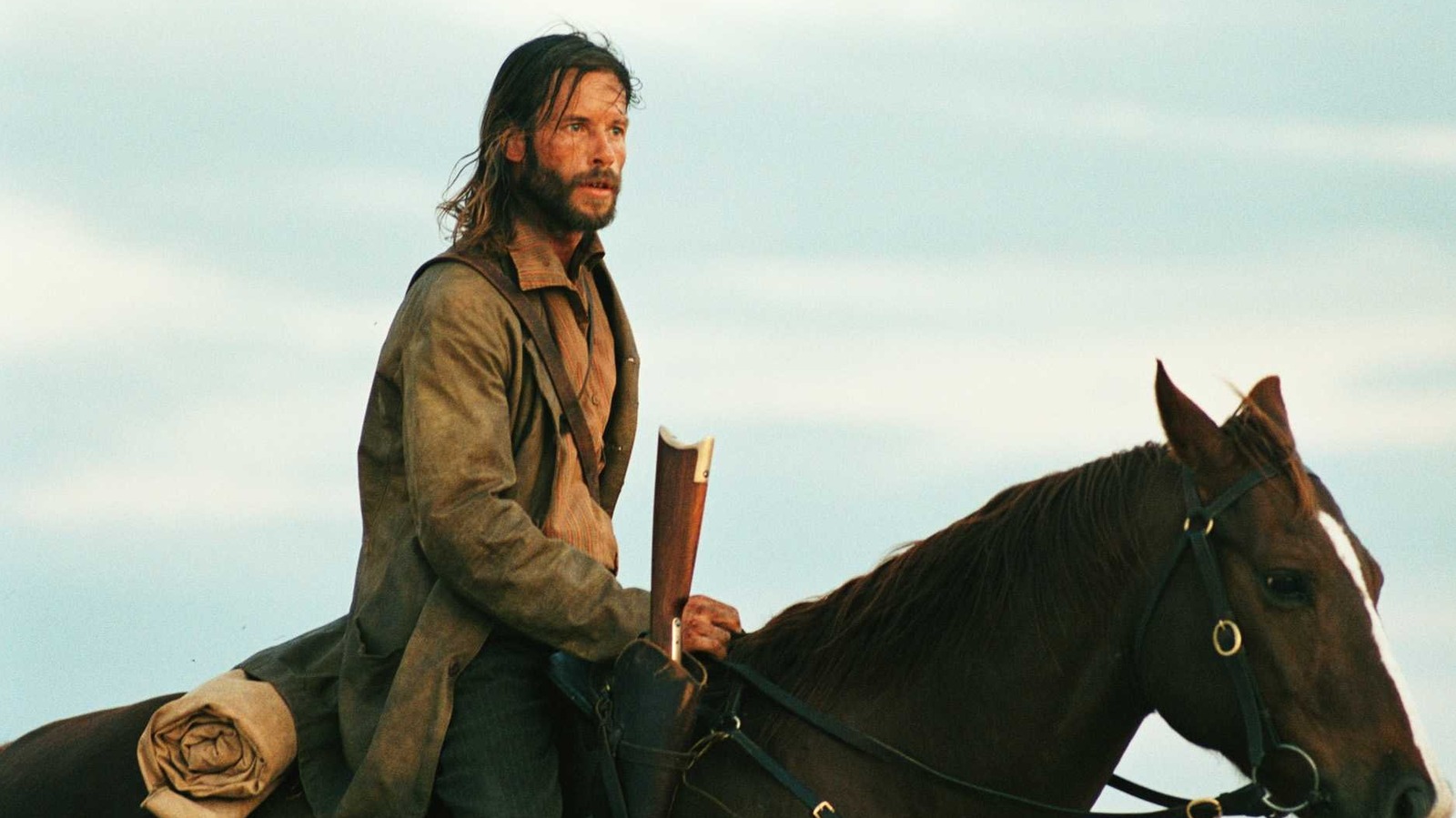
John Hillcoat’s “The Proposition” is an Australian Western with a tone more bloody and grim than we’re used to seeing, even in other revisionist Westerns. It has several Western plot threads, but each one comes to a shocking dead end. Nick Cave wrote the screenplay, and it meanders into every dark crevice.
Guy Pearce plays an outlaw named Charlie who was recently captured along with his brother Mikey (Richard Wilson).Their arresting officer, Stanley (Ray Winstone), has a proposition for Charlie. Mikey is slated for execution in nine days. If Charlie can find his criminal older brother Arthur (Danny Huston) and execute him before the nine days are up, then both he and Mikey will be set free. Charlie will find his brother, but whether he will kill Arthur or let Mikey be killed remains a question mark. It doesn’t help that the countryside is full of horrors and dangers, bounty hunters and bleak souls eager to kill.
Because most of the movie takes place in the Australian Outback, the makers of “The Proposition” took great pains to ensure that Aboriginal people and their culture as it was in the late 19th century were both presented as accurately as possible. In addition to being violent a-holes, the main characters are also colonizers, culturally guilty for the blood they spilled on that land. Keep an eye out for a cameo from David Gulpilil, the guy from Nicholas Roeg’s 1971 classic “Walkabout.”
I won’t reveal all the plot twists, but nothing turns out well for anyone. Some people are spared, only to go on to commit even more grievous crimes. The film presents a world where violence undergirds everything. Acts of just violence are no different from acts of unjust violence if everyone is dead by the end.
Takashi Miike has made over 100 movies in his career, and has dabbled in just about every genre. He may perhaps best be known for his horror movies, with flicks like “Audition,” “Ichi the Killer,” and “One Missed Call” making waves in the United States, but he is just as adept at surrealist epics (“Gozu”), superhero satires (“Zebraman”), and classy historical epics (“13 Assassins”). His latest movie is the sequel project “Bad Lieutenant: Toyko,” and he is a perfect fit for that kind of extreme, violent material.
In 2007, Miike took his crack at the ultra-stylized Western with “Sukiyaki Western Django,” a crazy hodgepodge of action movie influences, unfettered badassery, and broad character archetypes. The story kinda sorta recalled Akira Kurosawa’s “Yojimbo,” in that it’s about a remote Japanese town that is infected with a gang war. The guys in white are the Genji and the guys in red are the Heike. One of the Genji guys can cut bullets in half with his sword.
There are echoes of samurai classics, spaghetti Westerns, and numerous other genre pastiches. Quentin Tarantino appears in the film for a cameo, weirdly delivering his lines with a Japanese accent. That’s not as weird, though, as the fact that Miike hired an all-Japanese cast and then filmed his movie in English.
As the title implies, the movie is a mixed-up soup of action and Western violence. If it feels excessive, it was meant to be. Miike typically swings for the walls, making confrontational, noisy movies that get the blood pumping, even if one is baffled, upset, or dazed. Only a certain kind of cineaste will fall in love with “Sukiyaki Western Django,” but most everyone will walk away remembering its craziness.