Physical Address
304 North Cardinal St.
Dorchester Center, MA 02124
Physical Address
304 North Cardinal St.
Dorchester Center, MA 02124

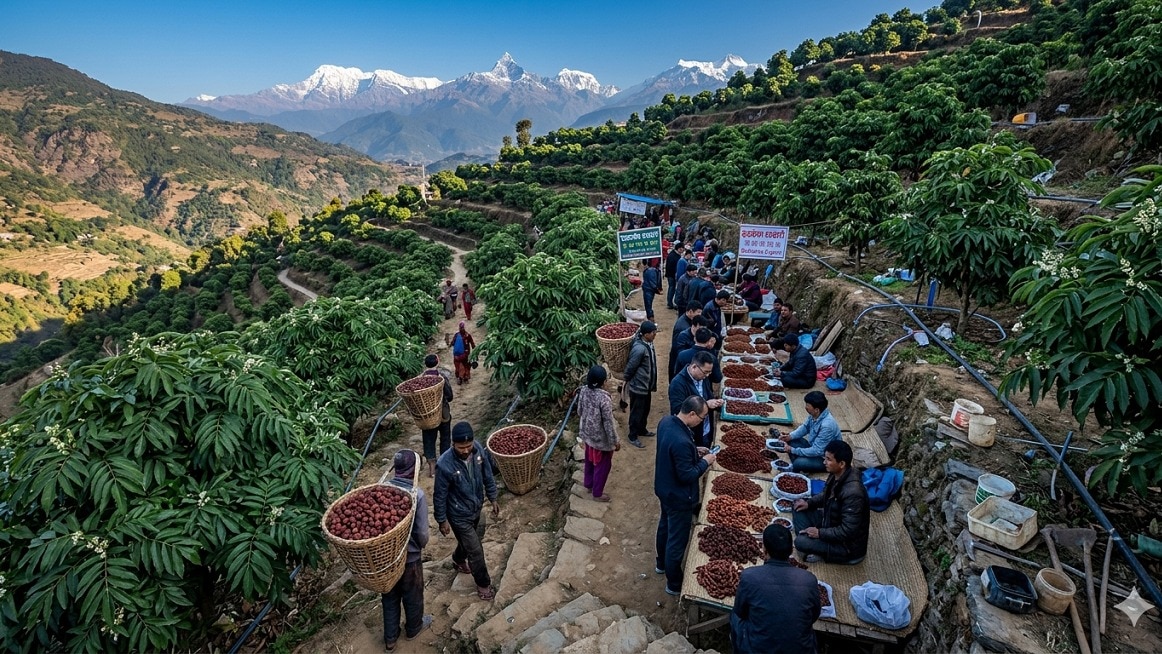
In the hills of eastern Nepal, a seed once bought mainly by Hindu pilgrims from India is now at the centre of a very different trade. Rudraksha, regarded as a sacred symbol of Lord Shiva, is increasingly being purchased by buyers from China, where it is valued more as a fashion ornament than for religious use.
That shift is most visible in Bhojpur district, where Rudraksha has moved from being part of a modest religious market to becoming a major export business. The change has brought higher earnings for growers, but it has also pushed many farmers towards using chemical growth regulators to alter the appearance of the seeds for Chinese buyers, raising concern about what this could mean for the trees over time.
According to report, Rudraksha has become a major source of income in Sadananda Municipality in Bhojpur, where there are more than 100,000 Rudraksha trees. Before demand from China rose, common five-faced Rudraksha seeds sold for about NRS 30 per kg. Now, prices can reach NRS 2,000 for a single seed, while rare multi-faced varieties can fetch millions of rupees.
Local authorities estimate that the municipality earns around NRS 1 billion a year from Rudraksha exports, giving it the reputation of Nepal’s Rudraksha capital.
“Currently, the farming of Rudraksha is high here; it is the major source of income for the farmers and locals here, as they plant it instead of crops. In an estimate, there are over one hundred thousand trees of Rudraksha and it is also acclaimed as the capital of Rudraksha in Nepal,” said Surendra Kumar Udash, Mayor of Sadananda Municipality.
Price of appearance
As the Chinese market has grown, so has the pressure to produce seeds that look a certain way. Farmers say natural Rudraksha does not attract Chinese traders as easily, and this has led to the increasing use of plant growth regulators.
Ashok Karki, whose family has cultivated Rudraksha trees for nearly three decades, said the change has altered the way farmers work with the crop. “The natural seeds are not that attractive,” he said. “To catch the attention of Chinese traders, we have to use these medicines. It has become a compulsion.” He said hormonal medicines are injected into buds at an early stage, sometimes up to four times. According to him, naturally grown seeds look spiky, while treated seeds appear stronger and more attractive before being exported to China.
Karki said this was not how the trade worked earlier, when Rudraksha was sold in its natural form because such medicines were not in use. Now, he said, farmers often feel they have little choice. Untreated seeds usually bring lower prices and little profit, even though the medicines are costly and do not always guarantee better returns.
The use of plant growth regulators, or PGRs, remains contentious because Nepal has not approved them specifically for Rudraksha cultivation. Karki said farmers and traders often obtain them through unofficial channels because they cannot be bought in the same way as ordinary pesticides or insecticides.
He said supplies have at times been confiscated by police and are often available only through contacts, with prices fixed arbitrarily. He also warned that continued use over several years could damage seed structure, reduce quality and eventually weaken the trees’ ability to bear Rudraksha as before.
Mayor Udash said farmers have been using PGRs on Rudraksha trees and described them as products also used in other fruits and crops. He said problems arose when growers assumed that higher doses would produce better-looking seeds. According to him, that led to withering in some trees, but farmers are now more aware of dosage and proper use would help avoid harm to other plants.
A trade serving two worlds
Rudraksha trees can grow from sea level up to 2,000 metres and usually take around seven years to bear fruit. The seeds vary by the number of faces, or ridges, they have, and the rarer varieties command higher prices. Udash said the trade now serves two distinct markets: India, where buyers and pilgrims purchase Rudraksha on the basis of religious belief, and China, where buyers are drawn by ornamental value and prefer attractive, good-looking seeds.
Farmers also sort larger seeds and shape fruits to suit those preferences. Over the past decade, Chinese traders have increasingly travelled to Nepal to buy directly from farmers and local markets, helping turn Rudraksha into one of eastern Nepal’s most valuable exports, even as concern grows over whether present cultivation practices could affect the future of the trees.