Physical Address
304 North Cardinal St.
Dorchester Center, MA 02124
Physical Address
304 North Cardinal St.
Dorchester Center, MA 02124
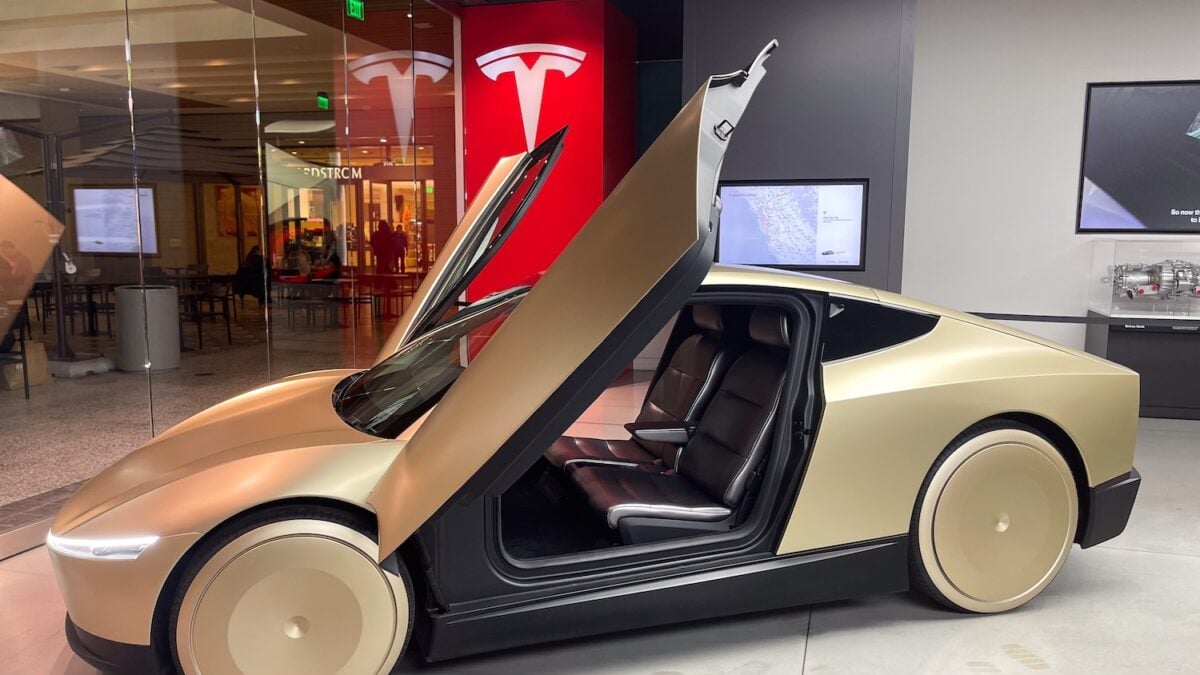

Tesla CEO Elon Musk announced earlier this year that the company’s upcoming stripped-down, two-seater Cybercab was heading into production. At the time, Tesla’s X account posted a photo of what it said was the first Cybercab off the production line at the company’s Gigafactory in Texas. Now, new regulatory filings have shed more light on the upcoming robotaxi.
The Cybercab is supposed to be Tesla’s “purpose-built fully autonomous vehicle” designed to power the company’s Robotaxi service. Since it is meant to be fully autonomous, it has no steering wheel or pedals. That also helps make it an unusually light EV.
Tesla recently filed paperwork with the U.S. Environmental Protection Agency (EPA), first reported by Car and Driver, that revealed that the Cybercab has a curb weight of just 3,113 pounds. For context, that makes it roughly 700 pounds lighter than the lightest Model 3. The filings also show that it runs on a single front-mounted 219-horsepower permanent magnet motor and a 48 kWh battery pack for an unadjusted 418-mile range.
The stripped-down nature of the car lets Tesla carry a heavy EV battery while still keeping the Cybercab around the same weight as a gas-powered compact car.
The Verge reports that, after EPA testing adjustments, the Cybercab’s real-world range will likely be closer to 290 to 300 miles. The outlet also reports that its 165 watt-hours-per-mile(Wh/mi) rating would make it one of the most efficient EVs ever certified. For comparison, the Lucid Air, currenlty considered one of the most efficient EVs, gets around 230 Wh/mi.
According to The Verge, the Cybercab could travel roughly six miles on a single kilowatt-hour (kWh) of power, compared with the three to four miles per kWh that many standard EVs achieve.
Despite the admittedly impressive specs, it is still unclear when the Cybercab will actually hit roads across the country in any meaningful numbers.
Last summer, when Tesla’s Robotaxi service first launched in Austin, Musk told investors that the company was planning to expand quickly into California, Nevada, Arizona, and Florida.
“We’ll probably have autonomous ride-hailing in about half the population of the US by the end of the year,” Musk said in a July earnings call last year.
Nearly a year later, Tesla’s Robotaxi service is still only operating in Austin, Dallas, and Houston.
One silver lining for the company is that Tesla has only reported 18 crashes involving its automated driving system to the National Highway Traffic Safety Administration (NHTSA), compared with 697 for Waymo.
But as Electrek points out, that is likely because Tesla’s robotaxi fleet is still tiny compared with Waymo’s. Tesla only has permits for 42 unsupervised Model Y robotaxis in Texas. Citing Robotaxi Tracker data, Electrek reports that only 14 of those were operating without a human safety monitor on board.
Waymo, on the other hand, operates a growing fleet of over 3,000 robotaxis across 11 cities.
Still, there are some signs Tesla is preparing to expand. Bloomberg reports that Tesla has filed plans with the city of Austin to expand an existing service center to add “robocar” car wash and charging stations. The company has also submitted plans for a Cybercab car wash in Las Vegas.
Tesla did not immediately respond to a request for comment.