Physical Address
304 North Cardinal St.
Dorchester Center, MA 02124
Physical Address
304 North Cardinal St.
Dorchester Center, MA 02124

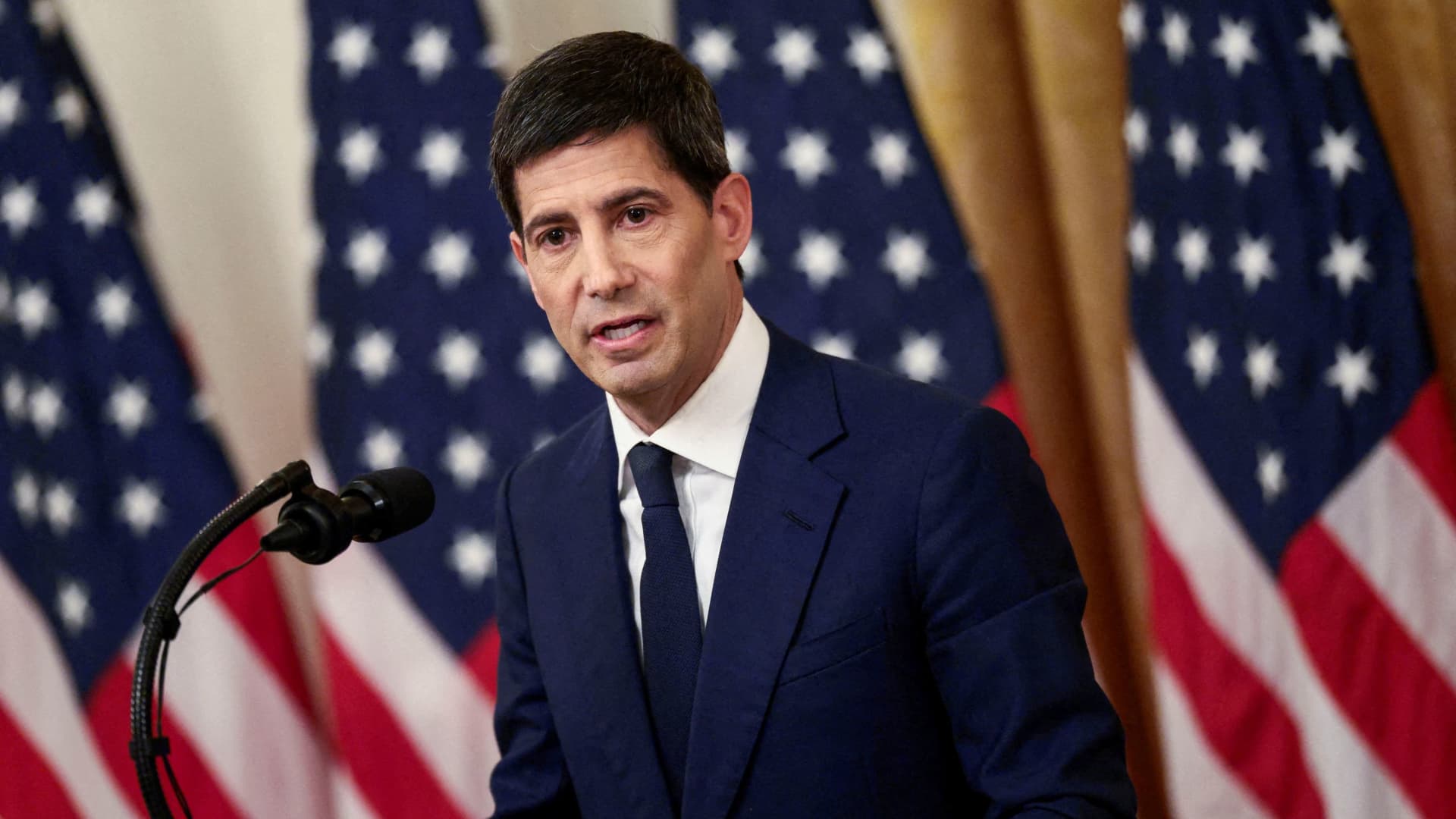

Amid heightened anticipation, Kevin Warsh will head his first meeting as Federal Reserve chairman but is expected do very little, at least initially, according to the latest CNBC Fed Survey.
The 32 respondents, including economists, fund managers and strategists, as a group see no rate change at this meeting or any meeting through 2027. But 88% do expect the Fed at this week’s meeting to remove the easing bias in the statement that has signaled the Fed’s next move would likely be a cut.
Warsh comes in as the hand-picked nominee of a president who has been bullying the Fed for years for lower rates. But high inflation, spurred in part by the President Donald Trump’s tariffs and war with Iran, have taken those cuts off the table for now and pushed them out of the forecast horizon for the Fed Survey and the Fed Funds futures markets.
“While Warsh is generally perceived as dovish, he will inherit a committee that has become noticeably more hawkish,” said Gregory Daco, chief economist at EY. “Several policymakers have recently argued that rate hikes should remain an option if inflation remains above target, and concerns around energy-driven inflation pressures have only reinforced that bias.”
Warsh himself has said rates could be lower but has not said if his outlook has changed amid the recent surge in inflation and stronger jobs numbers. The announcement of a potential deal with Iran, which came after the survey was taken, could give Warsh flexibility to cut rates sooner than currently expected. As it is now, respondents don’t believe that high oil prices will lead the Fed to hike but see the funds rate basically unchanged from the current level of 3.62% through 2027.
On the plus side, the survey shows Warsh taking the helm of an economy that has been resilient to recent shocks and expected to remain that way. Forecasters nudged up their growth outlook, lowered the probability of recession from 33% in April to 25% and reduced their expectations for the unemployment rate.
Economist Hugh Johnson writes in: “Improving economic and employment conditions and modestly rising stock prices are common characteristics of the current stage of the stock market-economic-interest rate cycle. Early warning signs of a bull market-ending recession have not as yet surfaced.”
The outlook for U.S. GDP rebounded to 2.2% for this year, up a quarter point for 2026, and to 2.3% for next year. Both recovered most of the downgrade from the prior survey linked to hostilities with Iran. The unemployment rate for this year and next is expected to be mostly unchanged from the current 4.3% rate.
Several respondents said the outlook for a healthy job market should lead the Fed to focus on the inflation side of its mandate, which it has missed for most of the past six years.
“The FOMC ought to hike rates to nip rising inflation expectations in the bud and get closer to neutral policy,” said John Ryding, chief economic advisor for Brean Capital.
Guy LeBas, chief fixed income strategist, Janney Montgomery Scott, added, “The period of short-term labor market fragility has passed, leaving the central bank’s mandate more clearly short on one side than the other.”
While lower rates have little support among respondents, Warsh’s ideas for changes to the Fed’s communications has backing. Fifty-nine percent believe Fed officials talk too much, compared with 38% saying it’s the right amount. That generally supports Warsh’s call for less talk from the Fed. But 59% expect Warsh to hold news conferences after every meeting, something Warsh would not commit to in his Senate confirmation hearing in April.
And when it comes to the dot plot, where officials write down their expectations for the funds rates in the years ahead, 53% believe it should be eliminated altogether. Most ideas for changing it — including releasing it days after the meeting or linking the dots to individual members’ specific economic forecasts — were rejected by majorities of respondents.
While inflation is viewed as the No. 1 risk to growth, the bursting of the AI bubble is a close second. A substantial 84% majority see AI stocks as overvalued, though that’s down six percentage points from December. The average respondent sees AI stocks overvalued by about 21%. Meanwhile, 69% see stocks in general as overpriced, the lowest level in a year.
“AI reality versus belief is a risk to the equity market and to consumers who depend on equity market gains,” said Drew Matus, chief market strategist, MetLife Investment Management. “The wealth effect is the likely conduit for the next downturn.”
Those concerns about AI reflect a generally muted view of the outlook for stocks, with the S&P 500 expected to near 8,000 only by 2027, a gain of about 5.5% from current levels.
Respondents, meanwhile, are less concerned about credit market risk. Just 53% now see the level of system risk in credit markets as “somewhat elevated.” In March, amid increasing worries about troubles with private credit, the level had reached 75% with an added 3% saying risks the risks were “extremely elevated.”
“Despite some dire forecasts, we see no widespread threats to the credit markets,” said John Donaldson, director of fixed income, Haverford Trust Co. “Any weakness is confined to CCC and CC credits….Certainly, nothing in credit spreads for financials shows any pressure whatsoever and that sector usually shows concerns first.
See full survey results here.